
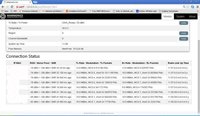
 These may be the first customers getting more than 10 megabits reported anywhere. Michael Davies and Richard Yu of 6Harmonics in Ottawa have sent me test data showing customers with a connection phy rate of 16-18 megabits, as well as convincing details from other deployments doing better than that. I thank Boston Consulting Group for pushing me to go beyond published reports and get these new results. The fuzzy photo below shows eight users connected to a base station using a single 6 MHz channel. They have deployments in California and North Carolina using two channels for nearly double the speed. High speed uplink is included.
They are ready with a three channel unit for even higher speeds. Yu has been working on multiple antenna systems (MIMO) for almost 20 years. I'm sure he can achieve even better throughput using more antennas. They seem to be so busy actually building the equipment they haven't had time to get the latest results up on their web site. CEO Yu, off the record, shared remarkable predictions for what they will offer within a year.
Professors Roy and Anant had sent me theoretical reasons why it would be hard to go beyond 10 megabits. I researched the publicly discussed deployments and couldn't find any going faster than 10. I used that figure in my early writeup of Microsoft's White Space proposals, which I called too slow. I was lucky I found this before I published. The 6Harmonic deployments are doing better than 10 megabits.
An engineer tells me he expects multiple antenna (MIMO) White Space gear within the year. MIMO with 4-8 antennas requires mixed terrain that allow the signals to reflect. It works poorly in the Australian Outback, which is most flat. It works well in most cities but not to all neighborhoods. Paulraj tells me Massive MIMO will work in flat topographies as well; the many antennas allow focusing the beams. Massive is now deploying at four carriers, with several more announcing they will soon deploy.
Berkeley's Anant Sahai, author with Kate Harrison of How much white-space capacity is there?, wrote me,
"Not that straightforward, in terms of direct extrapolation (based on what I *think* you are doing). As you will have seen from the Shannon capacity computations in our work: the link SNR is very spatially varying, depending on the co & adjacent channel interference from nearby TV towers. So this variation in channel quality must be accounted for in any reasonable estimate (so it's not just about channel BW)."
