In both November and December, ~5M 5G phones shipped in China. The monthly total is likely to go up quickly, as supplies of lower-priced phones are becoming widespread. In particular, the US$285 Xiaomi phone is now shipping. The December total phone sales were down 14% compared to Dec 2018, which may suggest people were waiting on the availability of less expensive 5G phones.
This is the official figure from the China Academy of Information and Communications Technology, CAICT. It is part of the Ministry of Industry and Information Technology (MIIT.) There have recently been inconsistencies in reports from China. Ten million "reserved" 5G in the first two weeks of October; a senior technical company expert expected they would get phones within a month.
That schedule hasn't been met. The Chinese press reported some supply shortages. Some people may have delayed purchasing phones as announcements were made of lower prices soon to come. I may have misunderstood press reports, which I read in Google translation. Some numbers could have been exaggerated.
China Mobile expects to sell ~100M 5G phones in 2020. China Telecom plans 60M. That's more than the official Chinese projection of a total of 150M in 2020, although China Unicom has not yet estimated publicly. I'll be watching closely to get accurate figures.
]]>2020 January Situation Report: Extraordinary growth in Asia, very little in Europe. Prices of phones, radios, and service falling. Performance as engineers expected, disappointing to non-engineers. Millimetre wave < 10%, Few Edge servers. No new use cases generating volume sales..
150 million: China plans for 2020, on target so far
15 million: Korea 2020 plan. 30% of the population
85%: Koreans covered end of 2019
~10%: Chinese population covered, end of 2019
>400,000: China radios deployed, 2020. Reduced from 600-800,000. Possibly covering half the population
1-2: Countries in Europe or North America 10% covered, end of 2019
1-3: Countries in Europe or North America 5-10% covered
126,000: China radios deployed, December 2019
45,000: Radios in Shenzhen, 2020. Complete city covered
9: Companies shipping 5G phones. 3 others, including Apple, announced.
US$285: Price of decent Xiaomi 5G phone. Several others under $500.
37: Telcos actually selling 5G. Several others claim commercial service. Dozens more by summer, 2020
50-150 Mbps down: Speed of slow 5G, about the same as 4G per Verizon and AT&T
200 million: Offered slow 600 MHz 5G by T-Mobile US. Speeds lower than good 4G, maybe 20% higher than T-Mobile 4G in the same spectrum.
]]>
 Verizon's Glenn Wellbrock, Director of Optical Transport Network Architecture, Design, and Planning, startled us at Light Reading's 5G Transport and the Edge event. Verizon is building 1,400 miles of fiber per month. Most talking heads think fiber is required.. But Glenn said:
"Don't underestimate wireless backhaul. We use that on about 10% of our sites and will increase it, possibly to as much as 20%".
Microwave latency is lower than fiber. Daisy Dunkley Clark of Ericsson wrote to me, "It is always the shortest path between point A and point B, and air is a faster medium than glass. A latency of much below 100 microseconds is fully feasible."
5 gigabit and 10-gigabit microwave are now standard products at a reasonable price.
]]>5 companies are making 5G chips: Huawei, MediaTek, Qualcomm, Samsung, and UNISOC/Ziguang Zhanrui. Apple intends to join them one day. Almost all are made at the 7 nm foundries of TSMC and Samsung. (Large chart below)
Huawei/HiSilicon only produces for their own phones, about 1/3 of the 5G market in 2020.
MediaTek has been #2 to Qualcomm in 4G, mostly with lower-priced chips. It is sampling an advanced 5G chip in January 2020.
Qualcomm has added the mid-range 765 to the premium 800 line and is pricing aggressively.
Samsung makes 5G chips for its own phones as well as Oppo. It's investing over $10 billion to increase capacity.
UNISOC/Ziguang Zhanrui, once known as Spreadtrum, has chip samples in testing. Backed by the very well-funded Tsinghua Holdings, it has the resources to win market share.
]]>Telstra "delivered 5X data growth at fixed cost by FY21." That required productivity improvement of 37%/year. Verizon estimates 40%/year. CEO Vestberg puts it another way: "Our cost per bit is 1/10th of what it was." Deutsche Telekom estimates 1/8th. None of these figures are exact, but the trend is obvious.
Wireless technology is improving at a ferocious rate. As we all know, demand for bits continually increases. The improvements in technology have generally matched the growth in traffic demand. Now that traffic growth is slowing, overcapacity is likely.
The rough equivalence between capacity and demand is confirmed by the financial reports of Telstra, Verizon, and most other telcos. Capital spending has been flat while generally meeting demand. Speeds have gone up dramatically.
Supply and demand explain much of what's happening in telco networks.
]]>A Chinese teardown of the Xiaomi Redmi K30 5G estimates the component costs at $250*, leaving almost nothing to cover assembling, distribution, support ... It will lose money on each one. Prices under $300/2000 yuan were expected by summer 2020. Xaiomi is six months ahead. It's a decent phone: 6.7", 120 Mhz screen refresh, 4 rear cameras including Sony's 64-megapixel IMX686, fast charging,sensor. It also supports 30W fast flash charging, and has a 4500 mAh battery.
Xiaomi founder, Le Jun, explains, " Today's China is an era of overcapacity." There are nine 5G phone makers in a market where it will be hard for even 4 or 5 to be profitable. Xiaomi has no choice but to find dramatic ways to break out of the pack.
The low price is probably a good idea. Since the days of the Hewlett-Packard calculators, electronics companies have often "forward-priced." Costs go down with scale and as the company advances "down the learning curve."The low price builds the volume to a point the company gets better parts prices. Low prices also build demand, for this and other Xiaomi models.
]]>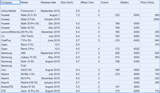 5G phone prices are down to $285!! 9 companies are selling 5G phones but the market will only allow 4 or 5 to be profitable. That's the China price, where 10M or more have already signed up. The 150 million subscribing in China next year are an enormous market. All the companies are doing what they believe they must to win market share. US & European prices are still $900 and up, as telcos go very slow on 5G.
The chart below has phone, china price, weight, number of cameras, and size for all phones shipping as of December 13. The updated master is here.
]]>
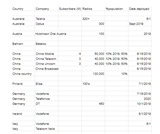 Over 30 networks are actively selling 5G to consumers. About as many more carriers have told the press they are active but are really still in trials. T-Mobile US has a low-band offering it considers 5G but is slower than most 4G. I think that's a scam and don't include it.
The latest live list is here. Below, the list from Dec 26, 2019
Errors and additions [email protected].
This work is licensed under a Creative Commons Attribution-NonCommercial 4.0 International License.
]]>Ten million Chinese "reserved" 5G phones in the first two weeks of October, a powerful signal of high demand. Huawei thought they could all get phones in October. But the official figures are less than 1M 5G phones in October and ~5M in November.
WTF? It could be an ordinary problem of ramping supply of a new product. It could be the official figures on phone sales are lagging reality by several weeks.
It might also be that millions aren't following up on their reservations. In October, most 5G phones cost $700-1200. In November, prices fell to $453. Xiaomi just announced a decent 5G phone for $285 (1999 yuan,) starting to ship in January. The Chinese press actively reported the price drop, although the initial supply has been limited. Smart buyers may just be waiting.
But it's also possible the 10M figure was not right. Contrary to Western reports, the major Chinese companies do not routinely lie about things like this.
A few years back, the Chinese figures for FTTH were hard to believe. But I checked with the chipmakers, who confirmed China was buying that many chips for FTTH.
There's enormous pressure on the telcos to "accelerate" 5G, which was supposed to stay in trials until summer, 2020. They haven't provided any details of the second half of October or of November. Maybe something is in fact wrong.
The ten million figure is prominent in the raised projections for 5G subscribers and I hope it is accurate.
]]>
Xiaomi's first 2020 phone is US$200 cheaper than anything else in the world, half the price of many, and less than a third of the prices in the West. Huawei and China Mobile expected the price to fall under $300 in the summer of 2020. Shipping in January, Xiaomi has moved 6 months before anyone anticipated.
Lu Weibing of Xiaomi is seizing "a historic opportunity" to win market share for the next decade. Huawei has jumped to over 40% market share in China. The low price is a weapon against the Huawei Honor brand, Lu is
"Very confident that K30 will completely crush the V30 of friends. This product must be the turning point between the two brands. We will form a crushing trend."
The Redmi K30 5G uses the new Qualcomm Snapdragon 765G, priced lower than the 865G in all prior Qualcomm 5G phones. While chip prices are confidential, Qualcomm has reduced the price differential between the 765G and 4G chips. The 4G version of the K30 is $230, only $55 less than the 5G.
It's a decent phone: 6.7" screen, 64-megapixel camera, 120Hz display, and a 4500 mAh battery. When I told Jennie the specs, she asked, "When will we be able to buy it in the US?"
?$150 by the end of 2020.
]]>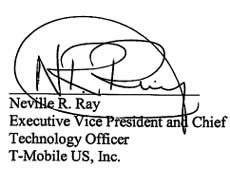 Only wireless engineers will believe Neville Ray's sworn statement, "We have publicly announced that we will commence building the T-Mobile 5G network in 30 cities, including New York, Los Angeles, Dallas, and Las Vegas, during 2018. Because 5G-capable devices are not yet available, we do not anticipate offering 5G mobile services until sometime in the first half of 2019. This network build will include approximately xxx cell sites and will provide an average throughput of 25 Mbps."http://bit.ly/NevilleRay
AT&T's 4G network averaged 70 Mbps in May of 2019 and T-Mobile slightly over 50 Mbps. (PC Mag, picture below) It's usually higher now, especially where equipment was upgraded for 5G.) On 4G, PCMag actually tested live service in Manhattan at over 500 Mbps. (Using advanced LTE & LAA.)
25 Mbps average for 5G must be impossible, right. WTF?
What every wireless engineer knows is that low-band 5G is really 4G with some software, 5G NR. 5G NR does almost nothing for performance.
]]>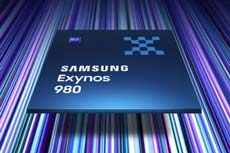 Samsung is now selling the 5G 980 chip to Vivo, the Chinese giant. This means Samsung is now challenging Qualcomm for 5G chip orders rather than only supplying their own phones. The competition will continue to drive 5G phone prices down. By summer, expect $300 phones. By the end of 2020, 5G phones may be as low as $200.
It will be used in the Vivo 5G X30 phone, shipping in December. The rumored price is US$455. It supports both SA and NSA 5G cores, a requirement in China starting in 2020. Vivo hopes to sell 100 million phones in 2020.
Separately, Mediatek is now sampling the Dimensity 1000 5G chip.
]]>China Mobile Vice President Jian Qin says the company expects 70-100 million 5G sales in 2020. Wang Hengjiang, Deputy General Manager of China Mobile Terminal Company predicts 150 million or more 5G phones will be sold in China in 2020.
Prices will go down to US$300 by June or July and ~$200 by the end of the year. Wang Hengjiang also predictedthe scale of the second half of the year will be scaled up. By Q1, there will be several 5G chips available. In the second quarter, less expensive chips should hit the market, allowing the summer drop in phone prices.
By the end of 2020, China Mobile expects to cover between 600 and 700 million people with a 5G network. The 2020 plan is for 600,000-800,00 5G cells.
These plans are far ahead of anything in the West, but the Chinese carriers have shown they can produce remarkable results.
]]>"It works" Greg Sherill of Verizon confirmed. Verizon has installed thousands of systems five years after first proposing NG-PON2. "The traffic seems to be just fine. What's in the field is working." Video below
Hesse, founder of the NG-PON2 Forum, Broadband Forum Board of Directors Member, BASe Chairman and Senior Director of Standards Marketing and Thought Leadership for Calix, sat down at Calix ConneXions with us and provided a look from the beginning of NG-PON2 to the future. Video below
Vince O'Byrne of Verizon drove the project forward starting in 2014. Verizon had decided that 10 gigs would not be enough for their millimeter wave 5G. Tunable lasers, the key technology, were very expensive but the price was falling.
NG-PON2 uses four frequencies, (wavelengths, lambdas) each with 10 gigabits. Combining them yields 40 gigabits as transmitted, 36 gigabits net. 40 gigabits from the bonded wavelengths is still in the lab and soon will reach the field.
Going forward, using more wavelengths and higher speeds on each will yield 80 to 100 gigabits. Currently, standards groups are considering 8 wavelengths of 25 gigabits each. Research provides a clear path to much higher speeds.
Video by Jennie Bourne of Bourne Digital. http://bit.ly/BourneD
]]>
Nearly every 5G strategy in the world is being reconsidered after 10M Chinese signed up in a few days early in October. Huawei has been selling thousands per minute. 3.7M Koreans have also purchased 5G phones, with 5M expected yearend.
5G now has an excellent use case: people want to buy. My working figure for 2020 is 210 million 5G phones, but I need a month or two more data for any confidence.
See my new Analysis Branch.com for how China is doing it.
]]>
T-Mobile 4G faster than T-Mobile 5G. Sprint has covered 8%+ of the US population with robust 2.5 GHz 5G. IHS three city testing found 5G on 51% of tests in Atlanta, 32% in Chicago, and 25% in Dallas. The 25-40 million people Sprint covers dwarfs any carrier in Europe, where no telco has reported even 2 million people in its serving area. Adjusted for population, only Swisscom and Sunrise Switzerland come close. (Neither has released coverage.details.) The median download speed in Chicago was 124 Mbps, about as predicted.
Sprint's John Saw is an obvious candidate for CTO of the year. Despite a low capex budget, Sprint is bringing 5G to far more of the US than any other carrier. Verizon covered 7% of Chicago and lower percentages of the population in Dallas and Atlanta. AT&T & T-Mobile are far behind with coverage of 3% or less. "T-Mobile’s 5G median download speeds in both Atlanta and Dallas were slower than its non-5G mode speeds in each city."
At left, how T-Mobile serves Rockefeller Center and Wall Street but provides little in Harlem or Black Brooklyn.
]]>Karl Bode discovered that AT&T doesn't think 5G matters, at least to consumers. In return for eliminating regulations, the US telcos nominally provide all the information consumers need to make a good choice and the FCC needs to make sensible regulation. But as consumer groups and Congressmen alike demand accurate broadband maps, AT&T is resisting bitterly.
Require mobile providers to report on their broadband networks by speed capability rather than technology. The record reflects that speed is more important to consumers than the air interface used to provide it. AT&T therefore proposes that the Commission require mobile providers to report their mobile voice and broadband coverage with coverage maps depicting two service levels: (1) voice and broadband service below 5 Mbps download and 1 Mbps upload, and (2) voice and broadband service at or above 5 Mbps download and 1 Mbps upload.
Since the NR air interface is AT&T's definition of 5G, if that doesn't matter, neither does 5G. That's true in one sense - good 4G LTE matches the performance of 5G in low and mid-bands.
In addition, the AT&T comments were inappropriate. So I filed a rebuttal:
]]>China Mobile had 5.32 million 5G customers. China Telecom and China Unicom each have about 1.75 million. Almost all have signed up in the last couple of weeks. The pace will presumably pick up after the opening later this month. The monthly price is US$20-30/month. Phone prices are down to US$520-700. The telcos are giving only modest subsidies, typically $50-70.
Those figures have been widely reported in the Chinese press but not officially announced. These are mega-billion dollar companies with audited financials and stock listings. I believe the figures are accurate. If so, China will almost certainly have more than 25 million subs by yearend. A low prediction for 2020 is 100 million; 206 is a plausible working estimate. Data is still very limited, however; we'll know more by the end of November.
Korea reported 2 million phones sold by August. The carriers have confirmed 5 million expected by yearend,
One confusion: Some articles report this as 10 million "reservations" as people wait for phones.
]]>
The city of Shenzen will likely have more (robust) 5G radios deployed than either Verizon or AT&T for the next year. Robert Clarke reports Shenzen will have 15,000 5G radios in the next few months and 45,000 by August. One Chinese city has more 5G than the entire United States.
Neither Verizon nor AT&T have provided any real information about coverage but their figures likely will be lower. There is no technical reason for delay. The technology now is working for over 10 million people. The limiting factor is the carriers' investment budgets. In the West, investment has been flat to down.
Verizon & AT&T each have 60-70,000 towers and have virtually stopped adding macrocells. Well under half will be upgraded to mid-band or mmWave 5G. Verizon is adding some small cells, but probably not enough to match Shenzen figure.
]]>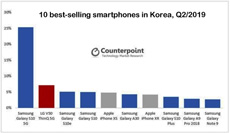
"Samsung’s Galaxy S10 5G dominated sale in the second quarter, followed by another phone available in 5G, LG V50 ThinQ with a share of 7 per cent, according to the data compiled by industry tracker Counterpoint Research." These latest results confirm South Korea's position as the first leader in 5G and show what's possible.
2 million Koreans have 5G phones. KT and SK are confident 10% of Koreans - about 5 million - will have 5G by the end of 2019. They estimate 30% of Koreans will go 5G in 2020. That would require well over half of the Korean phone sales in 2020 will be 5G.
If China by the end of 2020 matches Korea's 2019 figure of 2019, that would be 140 million. The US would be ~33 million. Almost all estimates except mine are lower than that.
]]>
5G rarely will need new cells, especially in mid-band 2.6 GHz bands. Very respected Huang Yuhang of China Mobile Research told the Huawei Chengdu event that CM will not need "to build lots of new sites for 5G or interfering with its existing LTE network. Its spectrum in the 2.6GHz band is sufficient to support both networks in a shared architecture."
Sprint in the US, which also has 160 MHz of 2.6 GHz spectrum, is getting excellent coverage of 5G despite dedicating half the band to 4G enhancement. Massive MIMO in mid-band is performing so well that 5G needs few more cells than 4G requires.
When 5G was defined as millimetre wave, the short reach meant many areas would need new cells. Then 3GPP redefined 5G to include almost any new system. Most notoriously, 4G TDD-LTE now is called 5G if a very modest software tweak is added, "5G NR." The software has a very limited effect on performance.
21 of the first 23 "5G" deployments are mid and low-band, with reach comparable to the 4G already in the network. Few new cells are required in the 2.6 GHz band. That's mostly true in the more common 3.5 GHz band, although the data is more limited.
Ronan Dunne of Verizon confirms the speed of the new "5G" is very close to 4G.
]]>2 million of the 51 million Koreans bought 5G phones in the first four months and 5 million are expected by the end of 2019. KT forecasts 30% will go 5G by the end of 2020. The only other reliable figure for 5G phones sales is from Huawei, which sold 1 million phones in the first two weeks. Everything else is speculation, usually from limited information.
From SK, the #1 mobile carrier: We believe that the 5G subscriber mark -- number will exceed the 1 million mark during August and we see that the -- by the end of this year, we will achieve at least 2 million. So it is indeed increasing at a faster pace than we had first expected. And in 2020, considering current trends continue, we expect that number to reach 7 million subscribers.
From KT: By the end of year 2019, we will see about 10% of 5G subscribers out of its total handset subscribers. And also in light of the broadening of the handset and device lineup and the stabilization of the network, we expect to reach around 30% by 2020.
]]>Ronan, CEO of Verizon Consumer, finally admitted what was becoming obvious: 5G millimetre wave would cover "significantly less than half of the customers." CEO Vestberg is backing off from his promise to bring mmWave at a gigabit to all of Verizon.
Instead, most will get about a third the performance of mmWave. Their "5G" connection, "will approximate to a good 4G service. ... The mid-bands and lowers are giving you in the low hundreds."
Most of Verizon's 30 million millimetre wave locations will be in "large, dense urban environments." Verizon's map will probably look like T-Mobile's: mostly business districts and affluent residential areas.
My Congressman, Adriano Espaillat, has told me of his anger that "Upper Manhattan is a fibre desert." Will Dunne ignore Harlem and the Bronx?
I hope to get a chance to ask Espaillat about 5G.
]]>
John Saw at Sprint, with an extremely limited budget, covered 11% of the US population in April 2019. Simply by upgrading existing cells, he's covered about 20% of New York, (At the top of the map is where I live.)
He hasn't yet reached most cities in the US or the most populous areas of NY, the black areas on the bottom of the illustration. I believe when he upgrades more cells, Sprint will cover more than half the US population.
In mid-band with Massive MIMO, Sprint's 2.5 GHz has reach comparable to the traditional lower bands. Sprint's 1800 MHz covers 95%+ of the city. The 5G coverage will be similar when the other cells in NY are upgraded.
Sprint's 160 MHz of spectrum at 2.5 GHz is one of the best holdings on earth. Saw already is getting good and sometimes contiguous coverage without adding any new cells.
]]>Could easily be 25%. T-Mobile as part of the Sprint deal committed to selling fixed wireless to 8% of the US. It has guaranteed that 90% of Americans will see mobile broadband service at speeds of at least 100Mbps if the deal is approved.
Goldman Sachs estimates Verizon will sell fixed to about 8% of Americans by then. That's ambitious. It's based on Verizon selling 25% of the market from cable in the ~30M homes Verizon will pass. Most are in the 70% of the US where Verizon has no good landline offering. It is pricing aggressively at $50-70, well under cable's price and offering much higher upstream. Verizon is still moving full speed ahead on mmWave, although Consumer CEO Ronan Dunne recently confirmed many consumers in other locations will be connected at lower speeds in mid and low-band spectrum.
CEO Randall Stephenson of AT&T, who will have a great deal of mmWave capacity to sell in 2021, has specifically said he will have a fixed offering. AT&T does not have landlines in over 60% of the US so will almost definitely sell fixed wireless. It has released no numbers yet, but certainly has plans well into the millions.
If T-Mobile-Sprint goes through, Dish is committed to covering 70% of the US by 2023. The primary product will be fixed wireless and Charlie Ergen is betting $10B he will sell a lot of it. He certainly will sell enough to push up this estimate.
]]>In by far the largest sharing deal in history, China Telecom and China Unicom will jointly build a 5G network with over 1,000,000 base stations. 80,000 base stations were planned for 2019 between the two companies, about 400,000 in 2020.
1 network is cheaper than 2 and 2 networks are cheaper than the 4-7 usually required for competition to work its magic. The Chinese government decided the cost of the third network was wasteful and directed the companies to work together. Zhao Aiming of SASAC urged, “The three operators should take the initiative to undertake national tasks and further strengthen cooperation to avoid repeated investment in 5G.”
No one has publicly estimated coverage, but 400,000 bases should serve the heart of most cities. China Tower has over 2 million cells, most of which will be covered by the pair. The announcement spoke of saving $30B in two years. In 2021-2023, it will probably be extended to cover well over 90% of China with 5G and an Edge Network serving more than a billion people.
The typical speed may or may not be more than the 100-500 Mbps down of the other 5G builds. 5G in 200 MHz will provide over 5 Gbps to share. CU & CT can provide a true gigabit to many if that's how they design the network.
They will have 200 MHz of contiguous spectrum at 3.5 GHz, double what every carrier except Sprint and China Mobile are using. The 5G standard only provides for 100 MHz, but Huawei has modified the standard to take advantage of China Mobile's 160 MHz and presumably of this 200 MHz.
]]>Mike Dano at Light Reading reports that Comcast and Charter, who represent the strong majority of US cable, have extended their MVNO with Verizon to 5G. Both companies have been asserting they will build their own substantial networks. One top cable exec, in private, has told me, "We will be huge in wireless."
Neither company will say whether they are reducing their plans for an independent network build. It's possible the companies will use Verizon out of territory while building in territory.
Both companies have a great deal of fiber and physical access to poles and manholes. Their home Wi-Fi can absorb much of the traffic. They can add radios for remarkably little. Everyone in cable thought their cost would be so low that adding wireless networks of their own would be very profitable.
Cable technology is in turmoil.
]]>LG Uplus in Korea sees 5G as a once in a decade chance to change market share. Will the earliest to build 5G gain market share in the West?
Almost certainly, I believe, many people will switch if a different carrier is far ahead in 5G. I cannot prove it, but the enthusiasm among consumers is obvious both East and West. 2M Koreans signed up in 4 months; more than 2M is almost certain in August 2019, the first month in China. Hans Vestberg of Verizon reports people are buying 5G phones even in areas where there is no 5G service.
Britain, Germany, Spain and Italy are probably under 2% coverage in August 2019, little more than pr. The phone prices in the US and Europe are often twice as high as in Asia.
Vivo is shipping a quality 5G phone in China for US$536.
]]>Josh Builta of IHS Markit could be right
"Within the next few years, prices will fall to between the $700 to $800 range."
I added the question mark because the Chinese price for good 5G phones is already down to US$536. China Mobile and others expect 2020 prices under $300. It would be very surprising if US prices did not come down further and faster than Builla predicts.
Perhaps the US carriers will find a way to keep prices high, I hope not.
From Bonilta:
]]>A million Chinese bought 5G phones in Huawei's first 14 days on sale. China in August may add three or four million 5G users. In Korea, 2 million signed up in 4 months. Korea has 51 million people. Adjusted for population, 5G would have 40 million in China or 12 million in the U.S. Germany, Britain, France & Italy have similar populations - and higher incomes - than Korea.
I wrote, Almost all 5G estimates for 2019-2020 need to be doubled. Strategy Analytics, the first mainstream analysis firm to jump in, tentatively raised its 2020 estimate to 80 million in China and 160 million worldwide. My guess is those will prove low. 5G phones are down to US$580 in China and falling to <$300. A reflection:
The best minds of telecom are going mad, starving for data, dragging through the Chinese press for an angry fix. Analysts are doing more than yacketayakking; two have told me their next reports will be very different. These are not teahead joyride neon blinking traffic light,
These are dreams of all who want a great Internet for everyone, no drugs needed. If I'm right, those left behind by a competitor moving faster will face waking nightmares. I hope friends who miss this don't become bleak of brain all drained of brilliance or disappeared into the volcanoes of Mexico leaving behind nothing. I glad no one will be burned alive in their innocent flannel suits on Madison Avenue.
With apologies to Allen Ginzburg, who saw the best minds of his generation destroyed by madness, (very rude link)
]]>The remarkable take rate in Korea and China is invalidating almost all projections of 5G subscriptions. The 5G promotion has consumers wanting to buy, buy, buy. Huawei Mate 20 5G is selling for only US$30 more than the 4G model. At that price, who would want to buy a 4G phone that could be obsolete in a year or two? In the first two weeks of sale, over a million Chinese bought Huawei's 5G phone.
One of the best analyst group on earth currently expects China to have 31 million subs in 2020. Two million+ Chinese are signing up in August 2019, a pace almost sure to increase. It's almost certain that China in 2020 will have more than that group's 73 million worldwide estimate. Korea is at 2 million after four months. KT is confident of 5 million Koreans taking 5G in 2019 from the three carriers. It estimates 30% of the country will switch to 5G by the end of 2020, about 15 million phones.
The new data is forcing everyone to rethink. If the Americans and Europeans switched to 5G in 2020 at even a quarter of the Korean expectation, that would be over 40 million.
Prices of 5G phones are plummetting in China. As I write, Oppo is selling a premium 5G phone for $580. Vivo is about to announce an even lower price. Nine phone makers are in active production and competition is becoming intense in Asia. It only costs about a dollar to airfreight a phone to Europe. The low prices are likely to spread and drive sales.
China Mobile and others say 5G phone prices will fall to under $300 in 2020.
]]> Vivo took 600,000 reservations before the official August 22 launch at US$536. It's a 6.4' premium quality phone. Previously, the cheapest phone was $580, the iQOO 5G from OPPO.
Vivo hasn't put a particle accelerator in the phone, but I couldn't resist the illustration. It has 3 cameras in the rear, a 4500 mAh battery, hybrid zoom, etc. OPPO may include AR glasses in a promotion.
Except for one Xiaomi, all the phones in the west are over $1,000. Airfreighting a phone costs about a dollar. Any carrier that wants 5G customers should send an exec to China, talk to OPPO, Vivo, Xiaomi, and ZTE, and have the most affordable 5G offering in the market.
]]>Huawei, ZTE, and Ericsson are financing China's 5G build by leasing/renting radios to China Mobile. Edison Lee of Jeffries estimates the carrier is paying about US$6,500.year instead of buying the units at $35,000. Radio prices in the US and Europe can be twice the China price.
Chinese carriers intend to deploy over a million radios in the next two years, which could mean $25,000,000,000 in off-balance-sheet financing. The carriers are honouring the government mandate to accelerate 5G while also claiming to hold capex flat. Wang Xiaochu, chairman and CEO of China Unicom, predicted that “the capital expenditure in the whole year will not exceed RMB 58 billion, and the 5G capital expenditure for this year will remain unchanged at RMB 8 billion."
Under government pressure to bring down prices, China Mobile saw an actual decline in sales in the last quarter. China Unicom saw a decline in mobile revenues.
ZTE has a $10,000,000,000 line of credit with government-owned banks. Huawei has over $30B cash on hand and minimal debt and can also cover the cost.
Nokia CEO Rajeev Suri has cut back in China, refusing to give the carriers what they demanded.
]]>The typical latency difference between existing 4G and new 5G is about 10-15 ms. 5G latency in 2019 is ~30 ms in independent tests in the US, Korea, and England. The latency is about the same in the other two dozen 5G deployments in 2019. That's what 5G equipment is designed for.
The chart is based on Open Signal data from Germany early in 2019. In LTE, Vodafone had 40 ms latency and Deutsche Telekom 42 ms. That's higher than the 30 ms typical of 5G, but not wildly so. Very few applications will be affected.
Latency on LTE networks will continue to fall as older equipment is replaced. New LTE equipment from Ericsson & Huawei brings air latency down to ~13 ms, only 3 ms more than today's 5G.
Latency will be reduced in many locations with Edge Networks (all of China) and/or improved backhaul/transport. (Verizon is doing both over the next few years.)
4G latency tests around the globe generally produce results between 35 and 55 ms. One LTE test at Verizon showed 23 ms and more than 55 ms is not uncommon.
1 ms latency is a myth outside the labs for years.
]]>
In the first 15 days of August, Huawei sold in China 1 million Mate 20 5Gs for US$900. ZTE is also selling 5G in China, with 6 more phones soon to hit the market. Oppo has announced a 5G price of US$580 for what looks like an excellent phone.
Sales have been growing month to month in Korea, now past 2 million. KT has estimated 10% of Koreans (about 5 million) will buy a 5G phone in 2019 and 30% by the end of 2020. I doubt China will go quite that fast, but the number will certainly be large.
There's every reason to expect the Chinese subscription figure to grow rapidly. The current plans are 100,000 to 200,000 radios in 2019, which will cover important parts of major cities. Beijing is mostly covered inside the 5th Ring Road already. 600,000-800,000 radios in 2020 will cover at least 50% of the population and possibly 75%.
I'm calling the December 2019 and December 2020 figures "guesses," not estimates. They could be low.
]]>
A million phones will ship in August, but the carriers are scrambling to deliver plans. They weren't ready when the government moved the startup date and are still scrambling to develop systems. In particular, they are holding back on announcing pricing. For now, all customers are on a free, 100 gigabyte/month "experience" program. With two million phones likely out in August and three million more likely in September, the telcos are looking forward to paid service soon.
Sina.com and other Chinese press sites report rumours that prices will be 199 to 599 yuan, US$29 to $85 per month. I suspect the figures are a trial balloon from the company because several pubs have the same details. In addition, the government is sure to want at least a low entry-level price to encourage takeup.
Chinese analysts speculate that 5G prices, at least as measured per bit, will soon fall.
]]>
Lee Hicks of Verizon has driven his cost down by 50% with his "One Fiber" program. He's replaced 200,000 old boxes with 20,000 modern, efficient pieces of gear. This is definitive proof that new networks are much more efficient than older ones. The technology is much better. (The latency also comes down.) Reliance Jio now has 330,000,000 million Indians on a network with such low costs that it is profitable at a price of US$5/mpnth. (Audited financials.)
Charlie Ergen's DirecTV will buy Boost from Sprint, assuming the state suits don't block the Sprint-T-Mobile deal. Boost will bring 9 million customers, a full retail operation, and some important spectrum to DirecTV, a very good start for a new network. All will be initially served through an MVNO deal with T-Mobile, but Charlie wants to build his own network as fast a practical. Ergen sees it this way:
"We have a lot of incentives to build our own network. I think it would be -- and not the least of which are severe penalties if we don't, but irregardless of that, we're going to build this network out and it's hard. All the incumbents have built networks that were primarily designed for voice and were built and designed architected in the '80s, but we're -- this is 2019.
]]>Rootmetrics found surprisingly little difference between indoor and outdoor performance in mid-band 5G at 3.5 GHz.mmWave gets clobbered by many kinds of walls and windows. Apparently, that's much less of a problem at 3.5 GHz. A team conducted hundreds of tests in Korea, the best independent study yet. The data on 5G downloads:
-
Indoor speed (out of 30 locations): 204 Mbps to 401 Mbps (median speeds)
-
Outdoor speed: 160 Mbps to 457 Mbps
-
Drive speed: 163 Mbps to 431 Mbps
Rootmetrics has done the best survey yet, but like all studies there are limits.
]]>When 5G was considered high-frequency millimetre wave, most expected the short reach would make it a poor choice for rural areas. However, 22 of the 24 current 5G deployments are mid-band, which seems to have decent reach with Massive MIMO. (Limited data.) Sunrise saw an opportunity to go after a market that Swisscom was neglecting. It offers both fixed and mobile.
In June 2019, Sunrise is covering 80% or more of 248 villages. It was able to do that simply by upgrading the existing towers, not terribly expensive. (I'd guess about US$500 per customer but I don't have enough data.) It intends to cover most of the country by the end of 2019.
It's quite possible that the mid-band networks will be fine in many rural areas.
]]>The pros are whispering, "AI is exciting, but most of it isn't ready to put to use." Caroline Gabriel, one of the very best analysts in wireless, surveyed many major operators and discovered a huge gap between what is being delivered by automation and the many brave words we hear so often. She writes,
Plans to implement advanced machine learning-based automation in 5G networks are grinding to a halt, with operators slowing investment and reducing their ambitions. ... most plans had gone backwards. Globally, only 18% expect to have more than 40% of functions automated by the end of this year.
Last year 21% of the same operators said they would have more than 60% of processes automated* by the end of 2020. Those hitting this 60% mark fell to 14% in this year’s study, suggesting respondents had been over-optimistic previously or that projects are snagged, or harder than they seemed.
[Without effective automation, the] business case for 5G in the period to 2024 will be severely compromised – resulting in higher costs, less network flexibility, lower ROI on 5G RAN and on virtualization."
]]> Mid-August, 10 phones are shipping. Prices in China are as low as US$580 (Oppo) but the price drops haven't yet spread to Europe or the U.S. Most phones are in good supply. The only available source with performance comparison is unreliable. The components used are very similar, so large differences should be rare. The Oppo is currently the cheapest but look at the quality of the 10x hybrid telephoto lens. Chart below.
With 2 million Koreans connected to 5G, we now have data. We have first reports from the U.S. and Europe to show how the technology works. China is going to take off in September and soon connect millions. Time to get real.
The big news: Customers are swarming. Korea is adding over 500,000 a month. In Korea and the United States, people are buying 5G phones even where they can’t get 5G. Who wants to buy a phone that will be obsolete in a year or two?
Phone prices are plummeting. Oppo offers a 5G high-end phone for US$580 in China. ZTE is at US$700. Huawei’s Mate 20 5G is only US$30 than the 4G version. The margins are better than 30% and prices like this will soon appear elsewhere. US$300 phones are due in 2020.
Companies are building faster than planned. In the U.S., Korea, and China, once one company got serious, the others felt they had no choice but to follow. I expect Germany and England will similarly accelerate by the end of the year.
Costs are much less than some predicted. When Verizon cut capex in 2018 while building 5G, I predicted 5G would not seriously raise capital costs. Since then, AT&T and Orange have predicted a capex drop and Deutsche Telekom promises flat capex.
Everyone in telecom is now rethinking 5G strategies. I - and many others - have revised up our estimates. If I'm right about the effect of a price drop, that will lead to very heavy sales in 2020 and 2021.
]]>Will the China price reach the rest of the world? Yes, and possibly soon. US$580 offers at least a 30% margin over parts and manufacturing costs, both of which are falling. 5G prices are headed under $300 in 2020 according to China Mobile, Huawei, and ZTE.
I believe demand for 5G will explode as the price comes down. So I've started the 5G phone price watch to track the market. It's on 5gwnews.com, a site I'm bringing back now that 5G is real. First items:
July 30 Oppo sets the price of its iQOO 5G phone at RMB 4,000 yuan (US$580.) ZTE's Axon10 Pro 5G version is priced at RMB 4,999 (US$725.) Both are high-end phones using a Qualcomm 855 chip. Huawei's Mate 20X 5G will go for RMB 6,199 (US$900,) only $30 more than the 4G version.
July 2019, phones appear in good supply, as do the parts required to make them. Three chipmakers are in production: Qualcomm (produced at TSMC's foundry in Taiwan,) Huawei (TSMC,) and Samsung (self-produced.) Both Samsung and TSMC have good capacity available at the most advanced node, 7 nanometres.
]]>There now can be no doubt that fixed wireless, mostly 5G, will be a viable business in the right locations. Today's wireless has enormous capacity, enough to supply the broadband needs of a significant population. It's better than most DSL and a workable alternative to cable in many locations. Traffic demand is falling, with Cisco predicting the U.S. will fall to 31% growth in 2021.
John Legere of T-Mobile committed to 9.5 million in-home broadband subs by 2024 in order to get FCC approval of the Sprint takeover. Brett Feldman of Goldman Sachs estimated Verizon will have 8 million by 2023. AT&T CEO says they expect a fixed market to grow in a few years. Wireless ISPs already have over a million. Starry and others are growing, In five years, at least a fifth of the 120 million U.S. homes will be connected wirelessly.
]]>"We intend to have the fastest 4G/5G network on the planet by next year," emails Sara Ibrahim Al Sayed, Senior Analyst, Investor Relations, Ooredoo. She added, "We currently have 100 MHz live at 3.5 GHz. The plan is to add another 100 MHz @ 3.5 GHz and 10 MHz @ 700 MHz next year but the exact timing is yet to be announced. In 2021 we will add a further 400-800MHz at 26 GHz. We already are one of the fastest 4G networks on the planet."
Using 200 MHz of mid-band spectrum would allow Ooredoo Qatar to offer higher speeds than almost all Europeans. No one in Europe is firmly committed to millimetre wave*, so Ooredoo will likely pull far ahead. The mmWave spectrum will bring Oreedoo speeds into the very top tier alongside Verizon.
The initial results are promising. Her colleague Rob Joyce tested 720 Mbps on a Mate 20 at Costa Coffee, one of the highest indoor results for 5G. (Pictured left.) I don't have much data on indoor mid-band speeds, but mmWave is clobbered by many walls and windows.
The competition around the Gulf is becoming fierce, with Zain, Etisalat, and Saudi Telecom also building 5G.
]]>Wenzi Long and Qu Ruihao of Sina.com drove 30 kilometres through the heart of Beijing, often finding signals from the 5,000 5G base stations already installed. They only tested outdoors. On an empty network, 50 metres from the cell, downloads were 1112 Mbps. At 500 metres, the speed went down to 210 Mbps.
They note, "In the densely populated buildings and thicker walls, the 5G signal is unstable and the speed is unstable." With ~80% of connections indoors, that brings down the average speed. In Korea, the average download speed is less than 200 Mbps
The most interesting thing in the article is ping times to Speedtest.net as low as 13 ms. Milan Milankovich at Ookla told me it has seen other very low readings from China. Given the air latency of 5G today is 8-12 ms, that implies a remarkable backhaul and transit network.
I didn't know China has started building their remarkable Edge network, which will connect over a billion people.
]]>July 25, I count 22 carriers that are selling 5G actively and about a dozen that are mostly pr. Literally dozens more are queued up. Alan Hadden counts 269 network operators investing in 5G in 102 countries. Do check the charts below.
All but 2 are using mid-band and likely delivering between 100 and 500 Mbps. 500-1,000 Mbps is possible outdoors in the right location. The first data on average speeds comes from Korea and is less than 200 Mbps. That makes sense because ~80% of connections are indoors. It will get better but not by that much.
Latency is between 25 & 35 milliseconds on most tests. That can be reduced to 12-20 ms by putting servers near the towers. The Chinese will install servers for over a billion people in the next few years. Almost everyone is testing or considering Edge networks but no carrier in the West has made a large commitment.
Verizon and parts of T-Mobile U.S. are using millimetre wave, with about three times the capacity.
]]>As prices come down, I predict 5G is going to explode. ZTE has just brought a quality 5G phone down to US$700. The ZTE Axon 10 Pro 5G uses Qualcomm's Snapdragon 855 top of the line chip. It has a 6.47-inch AMOLED display and a 4000mAh battery. The main camera is 48-megapixels, supported by an ultra-wide 20-megapixel lens and an 8-megapixel telephoto.
One reason Korea has 1.5 million 5G users is that competing carriers offering rebates have brought effective prices down to US$600-700. Next year, China Mobile expects prices to fall to $300 and I expect demand to accelerate. (I'm watching for parts shortages but so none have appeared.)
Meanwhile, Americans and Koreans are buying 5G phones even where there is no 5G. Who wants a 4G phone likely to be obsolete in a year or two?
]]>China Mobile identified energy efficiency as a major problem for 5G. Massive MIMO - 4G or 5G - is a major energy saver. The MMIMO advances are not quite enough to keep up with expanding usage but important.
China Mobile estimates each upgraded cell requires 50% more power. When you are installing 2 million cells, that adds up. (China plans 600,000-800,000 5G cells in 2020.) I've seen higher estimates.
Of course, each cell carries three to ten times as much data so energy and cost per bit are much lower. The 5G standard aims for a 90% reduction of energy per bit, although I don't believe that has been achieved outside the laboratory.
With an infinite number of antennas and other requirements rarely met in the field, interference can be reduced to very little.
]]>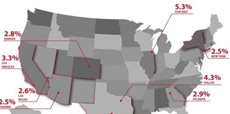 Soon, buying a 4G phone won't make sense except for the poor. Counterpoint Research is the first with data on where people are buying 5G phones, including in Korea. Many live in areas not yet serviced. Verizon 5G phone purchasers often live far from any 5G coverage, as you can see in the illustration from Counterpoint. Everyone in telecom is now rethinking 5G strategies.
In hindsight, it makes sense. Who wants to buy a phone likely to be obsolete soon? If you are buying a US$1200 phone, US$100-200 more is a reasonable price to pay for assurance you'll still be happy in two years. 70% to 80% of sales of Samsung's top-of-the-line Galaxy S10 are the 5G model. It has sold over a million units in 80 days, 12,500 per day.
My forecast is that sales of 5G phones will explode when prices come down. China Mobile predicts prices of US$150-300 in 2020, as does Huawei.
]]>Video surveillance and analytics is the first item in Nokia's suggested uses of 5G. (Chart at left and below.) I've come to the same conclusion, although surveillance usually isn't talked about and sometimes is actually classified.
Many are considering putting Edge servers with processing, AI, and data stores in telco networks not far from the towers. (MEC) That reduces latency from 25-50 ms to ~15 ms. That yields faster real-time processing and saves the cost of transmitting huge amounts of data to the cloud.
I've made a point of saying "Massive video surveillance," thinking Times Square on New Year's Eve as something beyond the state of the art that might need 5G. Researching this story, I discovered how much is and can be done without the 5G performance. Now, I wonder if 5G/Edge Networks will be needed.
For the millions of people living in Detroit and Chicago, face surveillance may be an imminent reality. Detroit's million-dollar system affords police the ability to scan live video from cameras located at businesses, health clinics, schools, and apartment buildings. Chicago police insist that they do not use face surveillance, but the city nonetheless has paid to acquire and maintain the capability for years.
According to one source, China already has hundreds of millions of active cameras, many doing facial recognition and feeding terabytes to information to databases.
]]>Verizon shocked many by specifying 30 ms as the latency on its 5G network. Its top officials predicted much faster connections; many, especially politicians, talk of 1 ms. In multiple independent tests, Verizon usually was somewhat better than 30 ms, down to 24 ms In Telstra in Australia, Daniel van Boom and Ian Knighton of CNET found 22 ms in a test. A thoughtful article. A test in Korea returned 25 ms. Several in England were 30-35 ms.
The latency can be brought down by putting special servers inside the carrier system, an Edge Network. Expect 15-25 ms depending on where in the network the servers are deployed. Most will be one to three routers from the cell, perhaps at a C-RAN or exchange. Some will be further back in the network.Verizon is also improving the transport and backhaul on its system, which could be almost as effective as a regional edge network.
1 ms works in the lab, but less than 15-20 ms will be rare on public networks for years.
]]>When I say anything of substance to D.C. officials, I try to make my comments public in the spirit of the FCC ex parte rules. (What they tell me is off the record unless they say otherwise.) Earl Comstock, back in government after many years, said something particularly cogent; China market of 1.4 billion people provides economies of scale that often result in leadership. So I sent him this note. There's nothing profound here but I thought he'd be amused.
Once the Chinese companies bring in the capability that’s organic to their nation, they have 1.4 billion consumers who will buy their products and then expand their revenues, increase their research and development, and then expand into international markets.
(The context was whether the world would ultimately choose 25G & 50G Ethernet for 5G backhaul, as China is, or the NG-PON2 Verizon is using. Technically they are about even, but he thought the Chinese economies of scale would prevail.)
We haven't spoken in more than a decade and I didn't know you were back in government.
]]>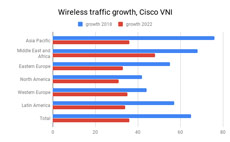 OFCOM, the British regulator, reports mobile data use per subscriber increasing 25% in 2018. Telefonica Deutschland expects the growth rate from 2017 to 2020 to be 37%, presumably higher in the earlier years. Cisco's VNI predicts North American wireless growth of 31% in 2022. The traffic growth rate is crucial to get accurate; it determines when a company needs to invest to avoid a problem.
In the chart at left from Cisco VNI data, the blue is 2018 growth and the red the projection for 2022. Every region falls. That corresponds to the experience of almost every country. Growth is rapid when smartphones are being adopted then falls off when most people have smartphones. In Australia, traffic spiked when Netflix arrived. Netflix is now in most countries, so that will be rare going forward.
The important exception is China. Government and company figures are growth over 80% in 2018 despite wide smartphone ownership. My guess is that the increase is due to increased TV watching, as video on demand services like Tencent Video, Youku, and iQIYI have grown very rapidly. Cable TV subscriptions have fallen the last two years at one of the highest rates in the world.
]]>According to a thoughtful 47-page analysis by the world's #3 manufacturer of 5G, Nokia. Looking at the top eight 5G use cases, Nokia confirms
"All are feasible with 4G."
The inference: 5G is not essential for most of the progress in these areas*. As I looked further into each of these areas, it became clear none of them are likely to drive demand growth sufficient to raise carrier revenue significantly. **
5G will be good for the industry because it will lower costs and increase capacity, not because of new uses. In addition, most consumers believe the myth of 5G miracles and are likely to buy. One million Koreans signed on in the first two months.
]]>"DT hasn’t hard launched anything yet, but has chosen to detail at considerable length how profound its plans to do so are." Scott Bicheno may be cruel but he's on target. "DT is generously offering its subscribers to pay for it anyway. You can shell out €900 for a Samsung Galaxy S10 5G as well as a 5G tariff and when DT gets its act together you can be among the first people to get access to its 5G."
Handelsblatt also refused to print DT pr. Instead, it wrote, "In a small area, the Bonn-based company has released a test network." Two other major newspapers apparently didn't even cover the "big" announcement.
DT announced that in six months they will have upgraded about 1% of their radios to mid-speed 5G. By yearend, Korea Telecom, SK Korea, and China Mobile will all be over 50,000 radios. DT's speed will probably be less than half the speed of what its T-Mobile subsidiary has deployed across most of Manhattan.
Germany has excellent engineers but DT is far behind in deployment.
]]>Qualcomm is rushing to deliver the X55 5G modem, designed to connect to the true 5G standalone core. The current combination, of a Qualcomm Snapdragon 855 application processor and X50 modem, will not be acceptable on Chinese networks after 2019. China has decided that 5G phones must be able to connect to the standalone 5G core, which the X50 does not do.
All current 5G systems use 5G for the phone connection but run on the 4G core. They are called "non-standalone" 5G, requiring a 4G network in place. The true 5G core, named "standalone," is not yet ready, but China wants to switch over as soon as practical. China Mobile is hoping for the first quarter of 2020.
The SA core is required for "net slicing." It also has many features that aid software-defined networks and other advanced technologies. But SDN is moving forward without the 5G SA core and it's not clear anyone will want to pay for network slicing QOS for years. Nearly everyone in the West is going slow on 5G SA.
Huawei's Mate-20 5G does support SA.
]]> Mike Apgar built one of the first Internet cafes in 1996. He went on to build Ookla and speedtest.net, with a pioneering spirit. It's now part of Ziff, but continuing to provide good information. They posted this map before I built mine and did a good job. (Make sure only "commercial availability" is checked.) I had missed that Etisalat in the UAE had gone live.
Here's my latest tally.
| Country | Company |
| Korea | Korea Telecom |
| Korea | SK |
| Korea | LG+ |
| U.S. | Verizon |
| U.S. | Sprint |
| UK | BT |
| UK | Vodafone |
| China | China Mobile |
| China | China Telecom |
| China | China Unicom |
| China | China Broadcast |
| UAE | Etisalat |
| Spain | Vodafone |
| Italy | Vodafone |
| Australia | Telstra |
| Switzerland | Swisscom |
| Switzerland | Sunrise |
| Soon come | |
| U.S. | AT&T |
| U.S. | T-Mobile |
| Australia | Optus |
| UK | Three |
| Finland | Elisa |
China will deploy more 5G radios in 2019 than the entire Western world. A low estimate is 100,000. 200,000 is quite possible. I'm closely watching as the information trickles out to understand the market dynamics. Shanghai is just getting going, with 2,000 radios in place. Beijing already has 5,500. Each of the three telcos is also actively growing 5G in a dozen or more other cities.
2020 will see 600,000 to 800,000 base stations according to Wei Liping of MIIT. As 5G phone prices go down towards US$300, many of the 300,000,000+ bought each year in China will be 5G.
The U.S. war on Huawei is unlikely to hold the country back on base stations. FPGAs are the only important base station part that may be dependent on U.S. suppliers. FPGAs efficiently replace a small circuit board of chips. Huawei already has a dedicated chip for base stations. At worst, FPGAs can be replaced by a small circuit board. DigiTimes reports Huawei is actively redesigning many boards to replace U.S. parts and meanwhile is slowing orders.
(Huawei will have a harder time replacing U.S. sourced radio frequency components for phones.
]]>Wei Leping of MIIT predicts, "In 2020, the country will reach 600,000 to 800,000 base stations deployed." Given the early results of 5G 2.5 and 3.5 GHz radios, I estimate 5G will cover at least 500,000,000 people and probably many more. The main areas of the largest 50 cities will be covered.
5G phone prices will drop toward US$300 in 2020 according to both Huawei and China Mobile. The gap between 4G phones and 5G phones will drop toward US$50 or less. At those prices, it's reasonable to expect that many of the 300,000,000+ phones sold in China in 2020 will be 5G.
This estimate of 5G expansion may be low. Minister Miao Wei has urged the companies to accelerate. Wei Leping also projected 80,000 to 100,000 for 2019. Nomura's expectation for 2019 is 172,000, which seems more likely based on the limited information available.
The entry of China Broadcasting into 5G will also spur the telcos to go quickly.
]]>Ted Rappaport's paper, Millimeter wave mobile communications for 5G cellular: It will work! inspired 5G. The new Wireless Communications and Applications Above 100 GHz: Opportunities and Challenges for 6G and Beyond points the way forward in wireless above 100 GHz. Ted and colleagues believe, "The mobile industry will be able to work well up to 800 GHz in the future using the small-cell architectures envisioned for 5G."
The reach of millimetre wave 5G is a major issue, due to signal loss. The paper discusses several ways to compensate for the increased loss in even higher frequencies. The key is that the antenna size goes down as frequencies go up. At 28 GHz, a 256 antenna module is the size of a chip. The beam will be pencil sized and hard to detect.
"THz will enable new sensing applications such as miniaturized radars for gesture detection and touchless smartphones, spectrometers for explosive detection and gas sensing [49], THz security body scanning, air quality detection [24], personal health monitoring systems [48], precision time/frequency transfer, and wireless synchronization [10], [22], [59]."
]]>Until the companies or MIIT reveal definite plans, it's impossible to give a firm estimate of China's 2019 build. China just moved up the date of officially going commercial, and Minister Miao ordered the telcos to accelerate 5G. Training the tens of thousand installers needed could hold things back. My guess is the higher estimates are more likely, especially after Minister Miao Wei ordered the telcos to "accelerate."
Analyst Joe Madden last summer predicted a "tidal wave" of China 5G. Early this year, Bing Dong of Nomura estimated 172,000 5G cells in 2019. Few in the West accepted those figures. After all, the combined networks of AT&T and Verizon are below 172,000 bases.
In February, the three Chinese carriers released capital spending plans for 2019. They weren't explicit about how many base stations they would cover, but my inference from their numbers was the 2019 total would be about 70,000. Several Chinese news sources continue to use similar numbers.
Late May, China Daily reported that the three giants would each have 30,000 to 50,000 5G bases in October, referencing ZTE and China Mobile. This week, Sina.com.cn reported an analyst estimate over 200,000.
The companies may be waiting for a few months results before making a plan.
]]>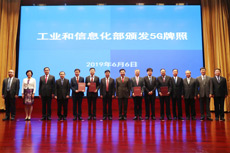 Until today, China's 5G was officially "non-commercial" but building rapidly. The country is set to pass the entire Western world before the previous Oct.1 launch date. See 90,000-150,000 Chinese 5G sites go live Octoberfor an earlier report.* Probably for political reasons, Minister Miao Wei just moved up the date. China Mobile, China Telecom, and China Unicom will build rapidly. They will be joined on the China Railway Towers by China's Radio and Television cable systems.
China Tower has 2.2 million sites and expects the carriers to upgrade most of them in the next few years. Towers and backhaul are in place. The upgrade will only require new radios, usually less than 15% of the cost.
]]> 1 network is cheaper than 2. 2 networks are cheaper than 4. Minister Miao Wei tells the telcos to "promote the sharing of 5G networks," and issues a detailed set of directions for how that should be done. (Below) Miao placed sharing second after, "accelerating the pave of 5G commercialization was listed before sharing." At left: Miao Wei (with glasses) smiles as he hands a 5G license to China Mobile.
China already shares towers in a separate company. The European regulators at BEREC estimate that brings down costs by 16% to 33% when two share. The interesting addition in the directions below is that indoor radios should also be shared, a farsighted opinion.
Comrade Miao also, "should thoroughly study and implement Xi Jinping's new era of socialism with Chinese characteristics, and resolutely implement the decision-making arrangements of the Party Central Committee." Of course.
]]>The green areas on the map show 5G availability in central parts of Abu Dhabi. The company has a similar map showing good coverage in Dubai. The National reports Etisalat is rapidly putting up 1,000 base stations. Those should be able to serve most of the 9.4 million population, concentrated in a handful of densely packed cities.
You do not buy a 5G service, just a phone. Your 4G plan will automatically connect to a 5G tower when in range. Service plans start from about US$50/month. The available phones are from XTE, Oppo, and Huawei, all costing over US$1,000.
]]>China Mobile Vice President Jian Qin: "5G mobile phones will be reduced to 1000-2000 yuan next year." (Google translation) (US$145-289) This corresponds to my earlier report from Peter Chou of Huawei that he is targeting $300 phones in 2020.
The question shouldn't be how they can go so low but rather "Why are 5G phones so expensive for now?" 5G phones are no longer mysterious. They require a better processor like a Qualcomm 855 or Huawei Kirin 980. A 5G modem and larger battery are also needed. The hardest part is the radio frequency front end (power amplifiers, transceivers, and especially filters.) 5G uses many more frequency bands. At the high speeds, only a few companies can make the parts.
The difference in the costs of parts (bill of materials) between 4G and 5G models today should be US$40-75. That will come down next year as MediaTek and UNISOC ship the 5G chips they have announced. Four companies - Skyworks, Qorvo, Broadcom/Avago, and Qualcomm/TDK - offer the RF parts, with several Chinese companies racing to deliver similar products.
Decent 4G phones this year cost US$200-300. Even US$110 buys a usable phone.
Next year, as always, costs will come down.
]]>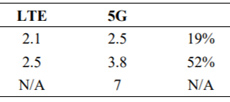 No telecom engineer will be surprised that Peter Clarke recorded 344 Mbps downloads on 4G LTE to a BT Huawei tower. LTE has been testing over 1 gigabit in the lab and hundreds of megabits in the field for two years.
T-Mobile CTO Neville Ray says that in theory the difference with NR should be 19% to 50%. In practice, I would expect less. If Peter had a 5G phone, the same spectrum at most would deliver about 480 Mbps. Huawei has improved 4G however, and the difference should be half.
Only salesman, politicians, and pundits believe ten times improvements from 5G. Interesting video of the actual test below
]]> Vodafone and Sprint are offering Hatch, a service created by Vesa Jutila and other former execs of Rovio Angry Birds. After three years in stealth, for £6.99 Brits will be able to play Angry Birds, Hitman Go and Monument Valley, and 100 other games. It is currently only offering traditional mobile games, designed for limited phones and connections. It will probably work well with low latency Edge Networks.
Tom Bedford believes, "5G gaming’s popularity could be dependant on its affordability, as people aren’t going to be likely to stream games if it’ll cost them a fortune."
For now, many telcos are pricing 5G at a premium. Hans Vestberg of Verizon estimates his costs are going down 90%. That implies that 5G prices will rapidly fall where competition is working.
]]>The 5G word from the companies, verbatim. Swisscom, Telstra, BT
Verizon only covers small parts of two cities with 5G, far under 1% of the population. The massive promotion has convinced many they are an early leader. They refuse to provide coverage maps or data. The three Koreans, Swisscom and probably Sprint have the only extensive coverage. So I'm sending a simple set of questions to all who announce deployments. Update 5/28 BT also pulled ahead of Verizon & AT&T, covering 8% of towers, about 1,000.
About how many people can buy your service? About how many cells are working? Can you estimate for 6 months from now and for three or four years from now? Do you offer a coverage map?
The three Koreans - SK, KT, LG - prove extensive coverage. Each covers about half the country with a year-end target of 90%, using a total of over 60,000 cells..
India is well along with the first large public use of blockchain in the world. The three giant telcos - Bharti, Jio, and Vodafone -are cooperating to build a system designed to cover more than a billion phone users.
Shared data will include "Soliciting entities, message aggregators, subscriber consent data and lifecycle event dates." Tanla, Tech Mahindra and IBM are providing the technology.
TRAI had ordered the companies to solve the spam problem.
This is based on reporting by Danish Khan at Economic Times. Worth a click for more information.
]]>
UNISOC/Spreadtrum will ship a 5G modem and full system on chip by late this year or early 2020. It announced the "5G technology platform" MAKALU and the IVY510 modem in February. It now has chips in test.
UNISOC has nearly unlimited backing from the government and Tsinghua Unigroup. 3,000+ engineers are led by Stephen Chu and other experienced managers. They intend to become a major international chip company. For several years, the then-named Spreadtrum cooperated closely with Intel on LTE and other chips. They now are on their own, hoping for an IPO in 2020.
China will have well over 130,000 5G base stations in 2019 and 1,000,000 bases amazingly quickly. Tens of millions will soon be buying 5G phones.
]]>In Spain, Italy, Switzerland, and England, a quality 5G phone is for sale this week at about US$400 less than the others. The Xiaomi Mix 3 5G uses the same Qualcomm 855 and modem as most others do except Huawei. It features a 6.39 inch full screen with a camera that slides out. The screen is an OLED with 2340x1080 pixels. It benchmarks well against other top of the line phones. The main difference in the much more expensive phones is better cameras.
Huawei's Mate 20 5G should have a similar price when it goes on sale after the U.S. delay.
]]>It's early, with minuscule deployments except in Korea, China, and the U.S. (next month.) Nothing's proven, but these conclusions look likely.
Works well: Government orders (China,) Gov "guides" (Korea,) Competition moves (Korea, U.S.)
Probably doesn't: Moderate changes in external costs (Small cells made easier, duct access.) Reductions in spectrum fees. (Most to shareholders, not investment,) Minimally useful spectrum (24 GHz.) Details:
Orders. With the approval of the Politburo, Minister Miao Wei directed the three telcos to build 5G at a ferocious rate. 100,000-200,000 cells in 2019; millions soon after. 25 ms Edge Network to 90%. Political power like that has an obvious downside.
]]>In a few months, China will have more 5G sites than the entire western world. "Michael Gao Wenhao of ZTE told China Daily that by Oct 1, China Mobile, China Unicom and China Telecom will each deploy 30,000 to 50,000 base stations in some 40 cities." Alex Cheng of China Mobile confirmed the story.
From other sources, I know that China will very rapidly go first to 1,000,000 bases and after that to 2,000,000. 90%+ of the country will soon be covered. The Politburo has decided that a great Internet will help the economy. Minister Miao Wei told the companies to do it.
No one should be surprised by the size of the rollout. In January, I reported the Nomura estimate that China will have 172,000 sites in 2019.
]]>BT told reporters they yanked the Huawei Mate 20 from the announcement because of the U.S. war. It forgot to take Huawei out of the press release. I discovered what you see at left when I pasted in for this article. (type made larger)I'm sure someone in the Chinese embassy is already talking to the government - if they can figure out who's running the British government as May considers how to resign.
The deployment is almost surely small. I draw that conclusion from the failure of BT to release availability maps or the number of homes passed/radios installed. The only interesting news is that the pr says BT will start URLLC in 2023.
]]>1.096 gigabits. 1.098 gigabits. 999 megabits. 941 megabits. ((Line of sight, < 200 meters) These are actual tests on Verizon 5G with a Samsung Galaxy 10 in Chicago. These are real people on real phones, three of them independent journalists.
10,000's have already ordered the Galaxy 10 5G, even knowing it will be rare to connect to 5G. Consumers want 5G; 400,000 Koreans have bought 5G phones in six weeks.
These results are about twice tests from a month ago and three or four times December tests. Almost everyone doubted high-frequency 5G would make sense. Neville Ray, CTO of T-Mobile, blogged the mmWave would only be a small niche. Craig Moffett, one of the best on Wall Street, wrote that the economics were extremely dubious.
mmWave still faces major obstacles.
]]>Tom Bartlett is CFO of American Tower. The company's 170,000 towers mean it is intimately involved with every major carrier in the U.S., India, and Brazil. His comments reflect the consensus views of the companies:
- 5G "relatively flat for a few years"
- Yearly "30% to 40% demand on the network"
- Massive MIMO and multiple antennas will be used on many/most sites to increase capacity.
Bartlett doesn't see much profit for American Tower in small cells and is directing investment to other products. Despite all the lobbying and self-congratulatory politicians, I haven't seen much of an increase in small cell building or more than modest interest outside the U.S.
]]>May 1, 2019. Korea has pulled far ahead in 5G, by almost every measure. Half the country is covered with 5G, with 90% expected by the end of 2019. Korea Telecom has 100,000 subscribers and the country 260,000. The hope is for 10% of users will be on 5G by the end of 2019, four to five million. SKT projects 6-7M subscribers by the end of 2020. That would suggest the three carriers will have 8-10M subscribers in a year. It will be difficult to impossible for any other country to catch up until 2021 or later.
Takeaways: The government "suggested" the companies move quickly, effective industrial planning. KT CFO Kyung-Keun Yoon on its financial call said, "The investment into 5G is actually inevitable for us." I believe this pattern will be common: one company moves fast on 5G and the others feel they must match. Ericsson data is:
More than half in China, one-third in South Korea and one in four in the US and Australia will change either immediately or within six months should this be the case.
Ericsson wants to sell radios and is not an objective source, but all indications are that if 5G is offered at the same price as 4G, consumers will buy. I expect this will especially be true later this year when numerous 5G phones hit the market at about US$600.
]]>Milo Medin, one of the most respected communications engineers, co-authored what should become the basis for all discussion of spectrum allocations. Most thoughtful engineers realized a few years ago that shared spectrum usually delivers far more capacity because more users will usually mean more radios. While today's phones are not "software-defined" or completely "frequency agile," many support dozens of bands and the networks can almost always find less congested bands.
The most important recommendation is
"DoD should recommend that the NTIA, FCC and Department of State should advocate the reallocation of the C-band satellite spectrum to IMT-2000 5G use at the World Radio Conference later this year (WRC-19), and take measures to adopt sharing in all 500 MHz of the band in the United States on an accelerated basis for fixed operations."
Almost all independent engineers conclude sharing is now the way to go. Columbia Professor & former FCC Chief Technologist Henning Schulzrinne in 2017 projected "All New Spectrum Likely To Be Shared." OFCOM and some EU experts have said the same thing to me. More sharing is implied in the important White House PCAST report.
]]>Neville Ray, T-Mobile CTO, thinks Verizon 5G is heading for disaster if they build mmWave to the planned 30 million homes. He wishes them "Lots of Luck" in the illustrations at left and below, illustrated with skulls. Top Wall Street analyst Craig Moffett has looked in detail at Verizon's mmWave and infers it is currently limited to under 200 metres.
Ray's blog (excerpt below) begins "5G is at the height of the hype curve right now and there’s also a lot of misinformation." On the blog, Neville has a striking very short video of how mmWave performance can be destroyed simply by closing a door.
On the other hand, Swisscom/Fastweb on May 2 committed three billion euro to bring 26 GHz mmWave to 8 million Italian homes. They are sure they will deliver a gigabit 500 metres. Ted Rappaport of NYU, the leading researcher, emails me, "5G small cell operating on mmWave spectrum should reach 100 to 200 metres in a dense urban environment, up to 900 metres in suburban areas."
Whether mmWave reaches 200 metres or 800 metres is the biggest unknown in planning for 5G.
]]>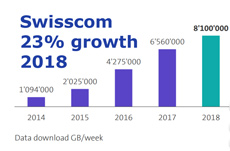
Wireless traffic growth is falling across the developed world, but the 2018 figure from Swisscom is lower than anything else I've seen. The Swiss figure may be an anomaly, but Cisco's VNI, a respected source, sees Western Europe growth in 2018 as 44% and North America 42%. In 2022, the Cisco projection is Western Europe 35% and North America 31%.
Update 5/12 Iliad/Free in France announced 28% in 2018 (end) In the developed world, the era of exponential growth is long gone. 100% annual growth is now just a memory, that ended when most of the population acquired smartphones. In India and Africa, only a minority have smartphones today, so growth is higher.
Verizon and AT&T both estimate wireless productivity growth of ~40% per year. Traffic growth and declining cost per bit roughly match. The result: Cost per customer is roughly flat. If prices are roughly flat, which is common, profit will remain roughly constant. In 2017 & 2018, profit at most major telcos has risen slightly. That confirms the Verizon and AT&T productivity estimates.
]]>Fastweb, owned by Swisscom, has announced the first large millimetre wave build (26 GHz) in Europe, intending to cover a third of Italy by 2024. That's actually more than Verizon's plan, adjusted for population. (Italy: 60M; U.S. 328M.) Verizon's current plan is 30M by 2024 to 2027, about a quarter of the U.S. Fastweb expects to deliver a gigabit 500 meters, using Samsung fixed wireless gear and all outdoor antennas. (That's ambitious.)
They are building a better network than Swisscom's own, I believe, which is sub-6 GHz and generally will run at a third the speed of mmWave. Xavier Niel is taking millions of mobile customers in Italy and will soon offer fixed as well. This is a competitive response, one more datapoint that competition, not higher prices, drives investment.
Telefonica Germany has a similar plan, according to CTO Cayetano Carbajo.
]]>We now have data from the field: 5G isn’t close to the hype, which implies that revenue growth will be limited. Fortunately, the costs are also coming in low. This report covers how smart builds and sensible choices in focus can help in an era of limited growth.
I needed a framework to think about 5G Strategy for an analysis report I'm writing for STL Partners. This isn't everything to consider, but it's a good starting point. Improvements welcome.
5G capacity/speed is not even close to the hype.
20% to 40% better than decent 4G at 2100 MHz or lower
~50% better at 2500 MHz through 4900 MHz (in theory)
Millimetre wave, less than 15% of 5G through 2025 or later, should be offer about three times the performance of 4G or 5G in lower frequencies.
]]>Nubia's Red Devil Mars, runs 5G at China Unicom, has liquid cooling, includes force feedback and vibration, and a graphene heat sink! The 48 million nominal megapixel Sony IMX586 camera can produce (some kind of) 8K video.
The 4G version starts at US$400 for a unit that outclasses the iPhone in many ways. Amazon sells earlier Nubia phones and worldwide marketing is beginning.
The phone is certified by the Tencent 2018TGA Grand Prix, sponsored by the 10% owner of China Unicom, games giant Tencent. Unicom was struggling, so the government brought in Alibaba and Tencent as shareholders and supporters. The joint marketing has been very successful.
450 million people watch esports and sponsors pay US$hundreds of millions to reach them. As you can see in the release below, the gaming features of the phone are remarkable.
]]>
In what I believe is the first announced telco drone surveillance plan, Saudi Telecom hopes to sell the Saudi Ministry of Defence and Aramco a large detection and interdiction system. Gear will be sourced from Australian company DroneShield under a Memorandum of Understanding, not a delivery contract. No use of the 5G positioning tools has been announced.
The Saudis are investing heavily in drones, including a domestic plant built by the Chinese. They hosted the Drone Racing World Championship in 2018. Saudi Telecom, as well as Zain Kuwait, have ambitious plans to sell Drones-as-a-Service. Deutsche Telekom offers the Magenta Drone Defense Shield. Vodafone is also investing in "The rise of drones." Neither has announced buyers.
Detecting small. low altitude drones is a challenge for traditional radar systems, especially as drones are becoming available with stealth material. Systems are likely to include a huge array of specialized radars, visible light and infrared sensors, and serious computer power to separate large birds and other moving objects from drones.
]]>Sprint's latest merger filing has 40 "redactions," holding back some of the most critical information the public needs to judge whether the transaction is in the public interest. Particularly egregious are the redactions of Appendix A & Appendix B. They don't even note the subject.
The usual reason for the FCC allowing such "highly confidential" treatment is the information would give competitors a significant advantage. I have reviewed some of the 30+ omissions and am confident that in many cases the information would be available to competitors from analysts and common industry sources. Some can be inferred from public Sprint statements.
Sprint's lawyers - Sam Feder, Regina Keeney, & Steve Sunshine - were once senior FCC officials and surely know the requirements. I believe they are all senior partners in important D.C. firms, jobs which probably pay US$5 million per year. They also know the regulations are almost never enforced, which I believe is a scandal at the FCC.
The filing concludes, "Absent completing its transaction with T-Mobile, Sprint will have limited options, and is likely to be forced down either a repositioning path and/or a restructuring path." Proponents of the merger believe that 3 carriers would be more competitive than 4 and/or the merger will have a major impact on 5G in the U.S. If those arguments are insufficient, likely insolvency might still win approval.
]]>A million here (Los Angeles), a million there (New York), and soon you are talking real coverage. At Brooklyn 5G, John Saw showed two slides showing 7 million people were already covered with a 4G/5G network with massive MIMO.
AT&T and Verizon refuse to release actual 5G coverage, implicit confirmation that the deployment, unlike the pr, in very modest.* Don't believe the hype.
The 4G is live, with something like a 4X capacity increase due to the 128 antennas. The 5G is also tested and will be turned on in a few weeks when the vendors deliver final production software.
Customers in a good location should enjoy 150-450 megabits down.
]]>Andre Fuetsch, AT&T CTO, paused for a moment to think before answering my question about telco cost trends. "“We've gone from 10 gigabits to 100 gigabits to now 400 gigabits on our fiber. MIMO and massive MIMO are extremely productive. Yes, I think 40% per year is a reasonable estimate of how our costs are going down. AT&T’s leadership in open white box and SDN will continue to drive that number higher, which is needed as network demand increases.""
Lee Hicks and others at Verizon estimated their costs were falling 40%/year. Does that that sounds right to you, I had asked Fuetsch. Andre had just presented the challenge he faces of continued traffic growth. Whether cost savings can cover the increased traffic carried is a major question.
I know cost accounting is heavily subjective; in a past life, I wrote accounting software. For example, Fuetsch leads both AT&T's capital spending and its operation. How much of his salary should be allocated to each?
]]>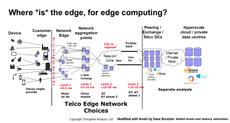 Carriers have to decide whether they want to offer ~15 ms latency or 25-45 ms latency. 25-45 ms is inexpensive because it requires very few servers, The number of servers and the cost is much higher for ~15 ms. (1 ms works in the lab but it will be years before it is widely deployed. I wish politicians would stop lying about that.)
Choosing where to put Edge Servers is one of the most crucial decisions to make in advanced networks. Very few are certain the demand is there and confident about spending heavily. In the diagram (larger below), I point to 4 Levels at different speeds and costs.
]]>
Every spring, the best telecom engineers in the world come to meet their peers. Ted Rappaport, Andrea Goldsmith, Gerhard Fettweis, slews of CTOs, and many others will present. Do watch the IEEE Livestream. Ted and Gerhard will present the future, including terahertz. I'll be asking about:
Reach of mmWave/density of cells required. Who will do mmWave in the next 5 years?
Latency of 5G air interface. Now 8-12 ms in the field, will it come down to the 1-4 ms in the lab?
Edge Clouds where? Tower, local in C-RAN or exchange, further back and slower?
How to simplify standards to bring down cost and time to market?
Who, what, where, when, and how?
]]>Officially, the builds at China Unicom, Telecom, and Mobile this year are not commercial deployments. However, China Unicom claims it is "continuously covering the core areas of 7 cities including Beijing, Shanghai, Guangzhou, Shenzhen, Nanjing, Hangzhou and Xiong'an."*
If so, Unicom's "test network" is substantially far ahead of Verizon or AT&T's "deployment." It is also ready in "hotspots" of 33 more cities. Until they release the actual number of radios or confirmed coverage maps, I have to consider the claim plausible but unproven.
Qualcomm's 855 chip is ready and half a dozen phones are sampling. Phone prices should be as low as US$600-700, but haven't been announced.
Unicom is using Ericsson equipment, because "Ericsson offered to sell its products for 21 billion yuan ($3.1 billion), or 25 percent below Huawei and 22 percent lower than ZTE’s offer. Nokia Oyj asked for the highest price at 34.7 billion yuan." Bloomberg Davy Zhu Standard Chinese practice would be to give the other vendors part of the contract. Nokia Shanghai Bell may be pricing itseld out of Chinese contracts.
]]>New H3C, a joint venture of Tsinghua Unigroup & Hewlett Packard Enterprise, is China's #1 in data centre switches, enterprise WLAN, blade servers, and security hardware. CEO Yu Yingtao tells Caixin it will shift in strategy to focus on next-generation telecommunication technology - including 5G small cells.
Datang, the TD-LTE pioneer, also is looking to compete with Huawei & ZTE for the million+ radios needed for China's 5G network. Datang is now part of Fiberhome, a primary supplier of network and IT gear. Mavenir, Altiostar, Parallel Wireless and others are also promising 5G small cells.
H3C goes back to a joint venture between Huawei and 3COM, Bob Metcalfe's old Ethernet company. The U.S. government eventually blocked the collaboration. 3COM was sold to HP, which continues to hold 49% of New H3C.
As you can see in this press release, New H3C has major international ambitions.
]]>The best results are on track. Korea Telecom is using 100 MHz of spectrum at 3.5 GHz and tested at 193-430 Mbps down. Upload was at 4G speeds. Verizon is using 400 MHz at 28 GHz and the best results were 600-900 MHz. Note that these almost all were clear line of sight, no windows or walls, and only a short distance. Two tests through windows saw a 60-80% drop-off.
Speeds will probably go up as the equipment improves; speeds will probably fall as more people connect. Below, a table with 7 independent test results. More very welcome.
430 Mbps corresponds to what Deutsche Telekom measured on a similar system in Warsaw and what Sprint & T-Mobile expect when they turn on their 5G:
In “daily-use” cases (farther away from the station, on a street, in our #5G_LAB building) we are registering speeds around 350-500 Mbps, which is really great considering the circumstances.
85% or more of "5G" will be similar to the Korean and DT systems. Verizon and AT&T mmWave should be about three times as fast.
600-900 for 400 MHz mmWave is actually more than the 450 megabits Verizon press release suggested. (Below) 400 MHz should provide 2-5 gigabits shared in the lab and often reach a gigabit to individual users. Verizon has 800 MHz to eventually use. No carrier has suggested consumer speeds above about a gigabit, although two gigabits should be practical for fixed wireless with larger antennas.
Lots of bugs, inconsistencies, and problems have to be fixed but the best results are on track.
]]>Ted Rappaport, the Prince of mmWave, is playing a key role in the U.S. FCC Spectrum Frontiers process to open high spectrum. It will be one of the signature achievements of Mike O'Reilly and Ajit Pai, although the practical consequences are years away. No one believed Ted (and Jerry Pi) in 2012 when they proposed using 28 GHz for mobile; today, Verizon and AT&T have a few thousand radios in the field starting to support customers.
Ted, John Cioffi, Dan Mittleman, Gerhard Fettweis, and others are working toward terahertz frequencies. Here're Ted comments to the FCC, looking ahead.
Testimony before the Federal Communications Commission, March, 2019
We have never, in the history of the US, opened up spectrum above 95 gigahertz (GHz).
]]>If Intel, still one of the most capable chip firms in history, couldn't produce 5G chips despite spending billions, the standard is clearly too complex. Someone needs to step forward and reign in 3GPP, brilliant engineers who clearly are unable to serve consumer interest. In practice, GPP has been throwing in far too many requirements in order to win consensus.
My best guess is the complexity adds perhaps 5% to the cost of 5G in the first few years. If others matched Qualcomm's royalty demands, that would add US$20-30 to the cost of the phone. Take your estimate of revenue, do the arithmetic, and realize how big the issue is.
Intel was a year behind Qualcomm in 5G. Beating Intel required some of the most intense engineering in history.
]]>It's common procedure at the FCC to ignore the rules about open disclosure. The latest Sprint filing "redacts" far too much. I sent this note to Sprint's lawyers and filed it.
Gina, Sam, Steven
I just reviewed your filing on behalf of Sprint and saw many redactions. I believe that at least four of the redactions were inappropriate, although IANAL. I was able to obtain from standard industry sources the figures involved. Any Sprint competitor would also be able to access that data.
In addition, you do not even indicate the general nature of the data you are redacted in the appendices.
It's a tragedy for all of us that Intel is abandoning the 5G modem business. It had little choice after Apple & Qualcomm cut a deal. That leaves Qualcomm with almost no 5G competition except Taiwan's MediaTek and China's Spreadtrum. Competition doesn't just drive down prices; it forces all to excel.
Intel remains one of history's greatest chipmakers, but Qualcomm is a year ahead of them in 5G, a remarkable achievement. Intel has lost US$billions in mobile and never found a niche. They will presumably take a large write-off in a few weeks and may fire thousands of engineers.
]]>China is just getting started installing what will very soon be over a million 5G cells. They will use frequencies from 2.5 to 4.9 GHz and deliver typical speeds of 100-400 megabits. What apparently is undecided is whether they will aim for ~30 ms (Verizon), 15-25 ms (Deutsche Telecom), or 10-15 ms?
30 ms is the least expensive, achievable by replacing older LTE with brand new 5G NR. That saves 35% to 45% from older systems most common in the U.S. That can be reduced by to 15-25 ms by installing edge servers and/or reducing the number of routers. (Verizon intends both.)
No one in the west has announced plans to go to every tower, which would require about 10X the number of servers. Highly respected Minister Miao Wei and Xi Jinping have hinted China might do so, and later cut the latency in half when URLLC is ready. Nothing is clear, especially because I have to read in Google translation.
]]>AT&T CEO Randall Stephenson says, "If you have deployed Huawei as your 4G network, Huawei is not allowing interoperability to 5G." I can't confirm whether Huawei or others are causing the problem, but there has been minimal interoperability testing. I've reached out to all the vendors to make sure I haven't missed important data in for interoperability, but they have none to offer. I infer from that interop is an important problem in 5G, although I haven't found any evidence Huawei is the main problem. Nokia, Ericsson, Samsung - please get me data.
Some problems are inevitable in 5G. It's so complicated that over 5,000 patents have been issued. In DSL, all the vendors bring their boxes to the University of New Hampshire, where they are carefully tested to solve problems. The engineers involved work in the spirit of "Let's fix things." CableLabs serves a similar function.
Hans Vestberg of Verizon boasts 5G is being delivered two years faster than expected. But his network and all others have been severely affected by the speed-up. Verizon has basically frozen their fixed wireless 5G Home for six months.
]]>Sometime between October 2019 and October 2020, China will have the largest 5G network in the world. The three giants - Mobile, Telecom, & Unicom - will rapidly deploy 1,000,000 base stations each, probably by 2021 or 2022. They will keep going, possibly past 2,000,000. Consumer speeds will mostly be 100-700 meg down. That's already decided and carriers are publicly committed. The three companies are negotiating sharing towers, radios, and even backhaul/transit.
Minister Miao Wei in 2016 set the goal of 25 ms latency to 90% of the country in 2025. At the time, his plan seemed ambitious and far ahead of anyone I Europe or the U.S. To everyone's amazement, the technology has advanced so fast that will likely be achieved by 2023. The question now is whether China will reduce that to 15-20 ms. With URLLC, that can be reduced to less than 10 ms soon after.
China is planning a major push in automotive, which may support a low latency build. Latency is important for AR & VR; the Minister's 25 ms may not be adequate. AR & VR are so important to the Chinese, the Chairman has spoken up. See Chairman Xi Jinping on VR: Go Gamers!
5G air latency today is ~10 ms. No one outside of China is thinking of putting servers at every tower.
]]>5G latency as deployed today at Verizon is 33-45% lower than typical American LTE, 30 ms as opposed to 45-55 ms for today's LTE. Verizon is building the most advanced 5G network in the Western world, although those early to Edge Clouds may pull a little ahead.
1 ms and even 10 ms 5G will be a fantasy for years in most of the world. It can work in the lab, but is hundreds of billions of investment and years from reaching the field. China this year is deciding whether to spend the money and probably will. No one else is thinking of doing similar until the middle of next decade.
Verizon's 30 ms is about the state of the art. It will probably drive latency down to 15-25 ms over the next few years. VZ is moving aggressively to improve the backhaul/transport network and install servers inside the network a few hops from the towers.
]]> KT is giving out free chicken and Starbucks coffee at the party launching 5G on April 5. This one is for real.* Seoul is covered and many other cities. By the end of 2019, 80% of the country will be ready. Korea's networks have more base stations upgraded than the entire rest of the world, excluding China.**
It will primarily be 3.5 GHz, with customer speeds mostly 100-400 meg. Lab/peak speeds will be a little over 1 gig, about the same as good LTE. They have demonstrated a combined LTE/5G system that could double that, but I don't know when it will ship. They are offering the Samsung Galaxy S10 5G for well over US$1,000.
The price will be US$48-70. The lower price has an 8-gigabyte cap. They wanted to charge US$62 but the government held up their permission to operate until they had a cheaper offering.
]]>
Minister Miao Wei, left, perhaps the most powerful man on the Internet, brought greetings from the President to a VR conference. "Virtual reality technology is gradually maturing, expanding human perception and changing product forms and service models. China is committed to achieving high-quality development and promoting the wide application of new technologies, new products, new formats and new models in various fields."
The First Secretary's support for VR could be a factor in China's decision about how to build 5G networks. China is going to install over a million 5G radios, mostly between 2020 and 2023. They may or may not put servers at the cell. The decision will be made in the next few months.
AR/VR is the only consumer application that really needs low latency and might drive volume in the next few years. If the Party Secretary and the Minister want VR, that could tip the decision to the faster (<15 ms) technology. No one in the West is going that low for years.
]]>Early 2019 GSMA Intelligence data show 737 million IoT connections at the Chinese carriers, more than half the world total. The U.S. has 109 million. Italy, Japan, and Russia have just over 20 million. The data is from GSMA, the primary source for world wireless data.
China Mobile had 551 million at the beginning of the year and expects to add 300 million in 2019. None is 5G, of course, showing 4G can accept many more connections. Massive video surveillance is the only application in sight that might require 5G capacity. Of course, the low cost per bit of 5G is always an advantage.
]]>Takeaway: Some but not many locations will support AR/VR servers in 2020-2022. The good news: It works. 5G + Edge Cloud networks are starting to deploy with 15-25 ms latency. Where fast enough, you will be able to move all your calculations to high-capacity servers which will do all the calculations and just send the picture to a lightweight headset or phone. Major companies including Tencent, Niantic Pokemon, and Verizon are already testing. Experts think quality VR will require 10-20 ms latency, right on the edge of what's coming.
The rest of the story. 1-5 ms is often promised. (URLLC) It works in the lab but is years away from meaningful deployment. Sorry. The best available in the next few years will be Level 2 Edge clouds, relatively close to the user, delivering 15-25 milliseconds. Deutsche Telekom has begun deploying a Level 3 Edge cloud, further back in the network, 20-30 ms. Without an Edge cloud, 5G latency should be 30-45 ms. Today, a decent LTE network is 45-55 ms average.
]]>China Mobile ended 2018 with 551,000,000 4G NB-IoT connections and expects to add 300,000,000 in 2019. It has covered 99% of the country with NB-IoT and is far ahead of anyone else in the world. 4G will totally dominate telco IoT for many years. IoT in 5G really is a form of the 4G tools. The marketing people are trying to hide that fact.
CM is building an ecosystem that is expanding outside of China. It recently signed a deal with Singtel. The software is from Huawei, which is rapidly building a worldwide cloud.
]]> Jessica and Craig Moffett, top Wall Street analysts, tested 40,000 locations in Verizon's Sacramento mmWave footprint against the Verizon availability. Unless there is a major improvement in reach, the cost would be much too high, (Update: Let me emphasize. The data implies a problem now, It can and will get better. Please don't conclude there will never be a solution.)
Verizon's current deployment in Sacramento is being built to an assumption of 100-150 meters, not the 600 meters Verizon has discussed often.
"Based on an exhaustive census of serviceability of 107 of the 273 small cells in Sacramento, each served an area of 27 eligible addresses." That will improve but there is a huge gap between these results and what Verizon needs to reach the target cost of US$200-350.
Verizon never released comprehensive data but they convinced many of the best on Wall Street (and me) the reach is much better.
]]> China's third largest carrier, Unicom, has brought in other private companies to manage a network with about the same population as Spain. The company reports outstanding results. (Below) While many companies, especially in India, will contract out building and even running the networks, this appears to be going even further.
Unicom itself is now an experiment in how to connect State-owned companies with private ones. The government persuaded Internet giants Alibaba & Tencent to each buy about 10% of the company and work actively with CU management. Rumors that CU would be merged into China Telecom have not proven true. The company has been struggling.
Initial Contract-out Reform of Yunnan Branch Showed Brilliant Results
⚫ Delegated management of the access network assets, network deployment & maintenance, overall business dealing to privately-owned operating companies, in compliance with the applicable laws & regulations
⚫ Contracted out operation with profit target set
]]> 5G latency in the US in 2019 should normally be 30-40 ms, down from 43-57 ms on LTE. The chart at left or follow the link. That's a 20% to 35% improvement, welcome but not game-changing. The "1 ms" latency is a fantasy.
Improving the backhaul/transit system and/or installing an Edge Cloud within the carrier network can bring that down to 15-25 ms in many places.
1 ms is possible in the lab with test equipment, but the actual gear going into the field is about 10 ms from phone to tower (Verizon and AT&T data.)
]]> SIx world-class engineers came together at NGMN Barcelona looking for answers to the question, "What are 5G Use Cases beyond Mobile Broadband?" Exciting new consumer applications are mostly years away. Will business services come sooner?
5G advocates promised 1 ms latency and multigigabit speeds. Autonomous cars would be controlled from that network. AR & VR needed latencies of ~5 ms to work well. Volume would explode on the 5G network. ...
Reality in 2019 is that 5G latency is between 15 ms and 35 ms, depending on how you measure.
]]>It's clear it's here. Get used to it. Verizon and the three Koreans are taking orders for 5G phones and will turn on the networks in April. Almost half of Korea is already built, mostly with 100-450 meg speed sub 6 GHz. No other country is close to half built, but AT&T intends to get there in 2020.
"We’ve talked about 200 million pops (60%) in 2020 being covered with 5G, that will be a software upgrade." CFO John Stephens
T-Mobile, which had to build a network for the newly-acquired 600 MHz band, intends to turn on NR across most of the country. It's almost a meaningless gesture; at 600 MHz, 5G NR adds very little to performance. (Much of the 5G enthusiasm is meaningless hype.)
At MWC, Huawei announced they had shipped 40,000 radios. Samsung has shipped 36,000.
]]> Lenovo-Motorola claims the only phone Verizon will sell for 5G will deliver 300-500 megabits, slower than good LTE from T-Mobile 4G. T-Mobile delivers 500 megabits in Manhattan using LAA. In theory, 5G sub-6 could offer 20-52% more capacity, but tools like LAA mean 4G will often be faster in the next few years.
The illustration from Motorola at left suggests 5G is 10X faster. 10X faster would be 5 gigabits using the T-Mobile comparison. Verizon elsewhere has reported LTE speeds over a gigabit. 10X would be over 10 gigabits, not 300-500 megabits.
]]>I first wrote: 4G 1.2 gigabits. 5G 1.5 gigabits. This is one of the first apples to apples comparison, both running on the same Samsung Galaxy phone. These are plausible figures for sub-6 GHz LTE and NR. The best available projections are that 5G in theory would be 19-51% more capable, so this was plausible.
The question mark is there because it's possible the 4G might actually be a third more efficient than the 5G. Cho Mu-Hyun at ZDNet discovered the LTE was three bands, presumably 60 MHz, with 4x4 MIMO antennas. The most common 5G testing uses 100 MHz. Adjusting for the spectrum difference would result in the 4G being a third more efficient than the 5G.
SK combined the 4G and 5G signals for a total of 2.7 gigabits in their test. That would be a remarkable advance if ready for market. I don't know anyone else doing similar. Samsung and SK haven't yet answered my questions about how much spectrum and product availability date.
Far too many companies, from Swisscom to Qualcomm to Verizon, refuse to provide basic information with their releases. Verizon won't give a meaningful answer about actual speed or about how many cells are deployed or the percent of the population covered.
]]>The core, the RAN, the home gateway and just about everything else will be in the cloud when e-commerce powerhouse Rakuten turns on Japan's fourth wireless carrier this fall. The system is working in tests today and the company is rapidly deploying radios.
CTO Tareq Amin played a crucial role at Reliance Jio, the greatest telecom disrupter of the century. He's bringing that spirit to Rakutan's new network, including a rare willingness to take chances on the newest technology.
Only a handful of people each decade have the opportunity to deploy a large greenfield network, Amin is now on his second one.
]]>The BOM for 5G is only ~$80 over 4G. Xiaomi's new flagship Mi Mix 4G is €499. 5G is €599 = much less than others hoped to charge. Oppo/Vivo wanted US$200 more. Xiaomi has now forced the market to something more reasonable. Everyone except Apple has a 5G phone to announce at Barcelona MWC. Likely, no one will show a phone actually working, fearful to be the first exposing how low the real speeds are for now.
Samsung was first to announce a foldable tablet, seven inches for US$2,000. Then Huawei came in at eight inches for US$2,600. Huawei claimed a download speed of 20 gigabytes/minute. I don't believe they were able to demonstrate anything close but I'm in NY, skipping Barcelona.
Almost all the announcements are very early. Don't expect many shipments until summer.
]]>Deutsche Telekom may be the first carrier in the world to install an Edge Cloud, which they are doing at a remarkably low cost. By going further back in DT's transport network, they reduced the number of boxes required from 10,000's of thousands to hundreds.
A cloud like this - highly reliable but not quite as fast - would be a very small percentage of a carrier’s capex budget. (A carrier has the fiber and other equipment in place.) It would cut the latency on your network by 40% to 70%. Perhaps more important, the latency would be much more predictable.
DT started with an initial dozen sites, which connected to almost all of the country. It is also installing at as many as 900 additional locations in the regions. This is a Level 3 Cloud - on the carrier's network but several hops from the towers.
]]>If drones stop shutting down airports, the telcos see a major business. Verizon CEO Hans Vestberg promised at CES 2019, "Verizon is committed to being the first to connect 1 million drone flights on its 5G network." Saudi Telecom, KT, Vodafone, and KDDI are doing active testing and hope to go into commercial operation in 2019.
The number of drone flights will likely be limited until practical flight control is demonstrated. 5G (and most 4G) networks can easily handle the modest number of drones in the air if human control is needed. Military and civilian research into truly autonomous control of drones is active worldwide.
Turkcell is using a Huawei system in 3.5 GHz. Verizon is working with Ericsson in mmWave.
]]>Now that nearly everyone in the developed world has smartphones, data growth is falling dramatically. The trend has been down for several years. Cisco sees growth in Asia-Pacific falling to 37% and Latin America to 34% by 2022. Folks who make business decisions on the assumption of high growth will be disappointed.
Since the technology is improving at something like 40% per year, that means either excess capacity or capex cuts. Verizon is building the most advanced wireless network in the world and cut capital spending in 2018. Deutsche Telekom, NTT DOCOMO, and Orange/FT have all told investors that capex will be flat to down as they build 5G networks.
The developing world continues remarkable growth, especially in India. Cisco's estimate for Middle East and Africa is 48% for 2022. As smartphones approach saturation, growth will slow.
]]>"Autonomous cars do not need 5G," respected Professor Gerhard Fettweis told us in the spring. Karl-Heinz Laudan of Deutsche Telecom agrees. "Automotive does not need mmWaves. I can now add an informed source, Don Butler, executive director, Ford Connected Vehicle Platform and Product. "These vehicles will be fully capable of operating without C-V2X." That's of course true. Otherwise, the cars would shut down when out of range of a cell site.
Connected cars - as opposed to autonomous cars - will be a major business. Ford is putting 4G in every car in 2018. AT&T estimates it has 27 million cars on the network today, although few have a second connection. That's mostly for entertainment today, but literally dozens of Waze-like information applications are coming to market. Butler predicts, "Road signs could provide advance warning of recent accidents or provide more context regarding road construction."
Dan Warren, now at Samsung, was the first to explain to me why cars couldn't be completely dependent on phone networks. "Will they freeze when they hit a deadspot? Of course not."
]]>In 2020, Edge Clouds can reduce latency to about 15-25 ms in 5G, ~10 ms more in LTE. Today's 4G LTE networks take 30 ms to 70 ms and more. Everything we do today works on 4G, of course. Some apps will benefit substantially from lower latencies, especially gaming. Some new apps will develop when lower latency is available. Multi-player Pokemon looks great.
To write Strategies for 5G, I needed to understand the impact of Edge Clouds. The first half dozen experts provided me with about seven opinions, often conflicting, They couldn't even agree on a definition. After a month of research and two dozen more conversations, I am less clueless. I divided the different Edge proposals into five levels.
Level 1 will require 1 ms 5G air latency, which is still in the labs. The 5G deploying is about 10 ms.
Level 2 is close to the cell, which adds 5-10 ms to the air latency. The first unit of the type is now installed in Chicago by Vapor IO. They promise nationwide coverage by 2020.
Level 3 is further back in the carrier network and a little slower. Deutsche Telekom's system, mostly constructed, expects 20-25 ms. That's the supply side.
]]>Enrique Blanco of Telefonica is collapsing his transport network from 8 to 4 layers. Lee Hicks of Verizon is "Ripping out 200,000 pieces of equipment as part of Verizon One Fiber." He is replacing them with one-tenth as many boxes. Cost and simplicity are the main goals, but latency is being dramatically improved as well.
I've recently discovered that the latency of the radios for the last 200 metres (the 5G NR) often is less important than the performance on the backbone. From the radio to the Internet typically takes 15 ms to 50 ms and more. 5G to the radio is now typically 10 ms, compared to 20 ms on LTE. That saves about 10 ms.
A better backbone (or an Edge Cloud) can reduce latency by 10-30 ms. Today's routers are much more powerful and much faster. Like most incumbent telcos, Verizon's network was loaded with out of date equipment, some 20 years old. Most carriers are slowly replacing older gear. Verizon One Fiber is replacing almost everything. Lee Hicks of Verizon is rebuilding that network with a goal of 5-15 ms.
]]>Cole Crawford at Vapor IO is building a network designed to bypass the telco entirely. He's installed an "aggregation box" a hop or three from the towers. Iyad Terazi's Federated Wireless is ready to connect it with a dedicated radio in 3.5 GHz shared spectrum. That's natural for certain kinds of IoT. The speed will be much better than the carriers. Interesting stuff. Packet, MobiledgeX and others are ready with the hardware and software that will make it work.
Cole gave me reasons he thought the telcos should buy in. Maybe. It's also possible services like IoT create enough of a niche to become profitable. Vapor says a single hub could serve hundreds of towers, which would bring the cost down. (I've asked how that would affect latency and am waiting to hear from the company. I would guess 3-8 ms with high performance gear but do not have data.)
What if Google, Amazon and a few others jump in to bypass the telcos? There's no evidence that's in their plans, but interesting talk. The software and programming talent at the web giants outclasses the ability of anywhere else. Google's network is the largest civilian system in history. It works well all around the world at an amazingly low cost. The scale dwarfs Deutsche Telekom, Vodafone, or AT&T.
]]>Where will the boxes go? Who will buy? Dozens of companies are jumping in, many with wild and contradictory ideas. "Levels of Edge" brings some order to the analysis.
Edge clouds reduce latency with servers close to the customer. The true believers talk 1-4 ms; the actual results for now are likely 15-25 ms. That's great for multi-player Pokemon, worthless for controlling autonomous vehicles.
Level 1 Edge Clouds don't exist yet and may cost too much to deploy. 1 ms 5G is still in the lab and years away from deployment. the 5G deploying is ~10 ms.
A Level 2 site is building in Chicago with equipment moving in. Vapor is supplying the main boxes. The server adds ~ 4 ms. Level 2 sites aim for 10-20 ms. Cole Crawford of Vapor tells Mike Dano their boxes are "tower-aggregated and connected, not tower-located." Vapor is not, as originally thought, going directly to the cell. Federated Wireless is testing a new radio network, which may be the only way to performance desired.
Level 3 sites are testing in live networks at Deutsche Telekom and in China.
]]>5G level service before 5G is deployed. Danish Mobile carrier 3, like most wireless companies today, has capacity going to waste. 4G Massive MIMO, Carrier aggregation, and other technologies advances are growing networks faster than the traffic demand grows. It covers 98% of Denmark and should be able to deliver the 40-70 megabits to most of the country. The 1 terabyte cap is enough for almost everyone.
Third and fourth carriers in many countries are suffering from a lack of customers. They have to think like new entrants and move aggressively. That does not necessarily mean cutting prices, although price cuts are an obvious choice. In wireless in particular, most carriers have excess capacity in most places. That allows you to drastically increase caps or video quality, both of which customers want. That's much easier when the marginal cost is low, like here. You can give more to customers without it costing too much. (Unlike, say, investing in fibre to the home. Although Telefonica and Orange seem to be making it work.)
]]>5G is not 5G is not 5G. 85+% of 5G will be mid and low bands, below 6 GHz. Typical speeds will be 100-400 megabits. In the U.S. Sprint holds a huge chunk, well over 100 MHz. China Mobile has 160 MHz. They can, and probably will, have better 5G than all but a handful of carriers who are doing mmWave. Huawei is ready to deliver equipment for maximum performance at 2.6 GHz.
Europe and Japan will do almost all of their early 5G in 100 MHz or less of 3.5 GHz spectrum. Higher signals, such as 3.5 GHz, fade so rapidly that until recently this band was unusable for broadband. With Massive MIMO, 100 MHz of 3.5 has the performance of 20-40 MHz in lower spectrum - with a spectrum cost of a quarter or less most places.
2.5 GHz has much greater reach, especially with Massive MIMO antennas.
]]>At least a dozen 5G phones will be announced in the next two weeks for MWC Barcelona. Some of them may start shipping as soon as April, earlier than expected. That's not guaranteed. The primary chips should be available but the front end of the phones - RF or Radio Frequency - also has been struggling.
End of March, Taiwan Semi promises volume production of 7 nm chips produced using an Extreme Ultraviolet system (EUV.) TSMC is taking delivery on 18 of the US$100 million-plus machines this year. Some will be tested on 5nm, with production expected in 2020. Samsung and TSMC have begun construction on 3 nm facilities that will cost US$20 billion.
]]>Except for a very few people in small parts of 4 cities (map at left and at PC Mag,)Mag,) Verizon will not sell you 5G until they get NR certified equipment. They are looking to Motorola and Samsung, who are both six months and more away from volume production.
After spending untold millions to be "first," Verizon has stopped opening 5G sites to customers. Hans Vestberg decided to wait until he could get 3GPP approved NR routers rather than those custom-built to Verizon's early standard.
]]>As previously reported, Ericsson is bringing the 4G latency close to 5G latency. In March, the company emailed me,
From mid-2018 Ericsson will have support for latency (Round Trip Time, RTT) down to 9ms on the LTE air interface (Based on the 3GPP Rel-14).
Verizon and others are being coy, but the reported latencies on 5G are also ~10 ms.
On speed, Ericsson now offers multi-Gigabit LTE for 2Gbps. This is consistent with previous reports. See 4G LTE: Telstra 2 gigabits, Singtel 1.5, Verizon 1.45. 5G NR low and mid-band will be slightly faster one day, but today is slower in practice since 5G doesn't have functions like LAA.
Below, the press release. It speaks of Massive IoT. I'll ask Ericsson for more info.
]]>1 ms 5G is years away but the first 10-15 ms Edge Clouds are sprouting up. A day after I said, "No one is deploying Edge at the cell sites," I discovered Vapor IO is deploying systems one hop away or sometimes at towers. Update: Vapor tells Mike Dano "Vapor IO is putting its edge computing functions," where they can "manage hundreds or potentially thousands of cell radios." Previously, they planned the opposite. At a guess, the difference is 3-8 ms. Apologies for my sloppy fact-checking. End update.
The first two are live in Chicago and they building over a dozen more. After four years and three funding rounds, they plan to launch 200 sites by the end of 2020. Goldman Sachs, Crown Castle, and private equity have been involved.
AT&T and T-Mobile/Nokia are rebuilding their networks for SDN/NFV and both are using OpenStack. Vapor IO has an interesting multitenant software system that provides a shared system (colocation.) CMO Matt Trifiro tells me they are actively signing clients. Part-owner Crown Castle has 10's of thousands of small cell and towers. It would be natural to do joint sales calls.
Trifiro tells me the Vapor Edge Modules will also go at "aggregation points" one hop away. With dedicated fibre, that may add as little as a millisecond. (Update. This is not accurate,)
]]>The three Chinese giants expect to install 172,000 base stations in 2019. That's more than the entire networks of Verizon & AT&T, combined. Officially, this is "non-commercial." It probably will be more than twice the entire rest of the world.
Under the direction of Minister Miao Wei, one of the best regulators in the world, the Chinese will be building 5G and edge clouds at an (almost) unbelievable pace. China Tower, owned by the three companies, is talking about bringing 5G to two million sites by 2022-2023.
That would mean 5G - and ~20 ms edge clouds will reach 70+% of China within four years, hundreds of millions of homes.
Huawei and ZTE will probably get a third of the orders each. That likely means they will be making more base stations than anyone else. Datang, now controlled by Fiberhome, is also hopeful.
]]>Real numbers are starting to trickle out. LG Uplus, Korea's #3, intends to "complete all major cities" in 2019. Korea's three telcos nominally went live in December, but are only accepting a handful of business customers. They expect 5G phones from Samsung & LG in March.
The other Korean telcos, KT & SKT, have a total of 3,000 bases deployed. All three are taking steps to fill their networks. LG is funding Korean game and VR companies. SKT is working with Seoul for an advanced traffic information system.
The Koreans have only discussed mid-band 3.5 MHz frequencies. Samsung and KT were pioneers in millimetre wave and I hear rumors. But I have no confirmation.
China will deploy 170,000 5G bases in 2019, Nomura reports. (I'm factchecking.) The Chinese also choose mid-band, including over 100 MHz to China Mobile at 2.5 GHz. CM also received some 4.9 GHz spectrum, which is used for Wi-Fi in the West.
]]>A report in Digitimes suggests premium 5G phones will cost about US$100 more than comparable
The production cost for 5G phones as compared to their 4G predecessors should increase by less than US$80 per unit, including an increase by almost US$50 for 5G modem chips and application processors, and the remaining US$30 for new antennas, PCBs and other materials, the sources indicated.
Digitimes stories like this have usually been accurate in the past. This is much less than the US$200 additional estimated by OPPO CEO Pete Lau.
Dan Adams of Deloitte estimates about a million 5G phones will ship in 2019.
]]>Latency, clouds, and how the telcos hope to take over
The 1 ms latency frequently touted will be available to less than 2%, probably much less. 300-600 million homes will be able to connect at 15-25 ms through carrier edge cloud networks. Most will be in China. (This and the other predictions are well-researched but of course not guaranteed.)
Deutsche Telekom is rapidly building a network to connect all Germans to servers within 20-25 milliseconds. Multi-player Pokemon has a great demo. DT is working with rivals. Timotheus Höttges and team have decided a project like this needs to reach the largest audience and are including rivals.
Carriers have monopolies on reaching their own customers. Many expect to charge a high price to use their edge clouds, which will be 10 ms to 30 ms faster than other choices such as CDNs. It is totally unclear whether the market for that kind of service will be large. I am more sceptical than most but very unsure.
They are already making deals, such as China Unicom with Tencent. Verizon is building game servers. The partnerships are logical, if and only if the terms work.
Telcos dream of a wireless umbilical cord between your phone or autonomous car and their servers
]]>Verizon CEO Hans Vestberg is generally a straight shooter, so I was surprised by his comment
"5G network equipment and devices will consume only 10% of the energy consumed by 4G network equipment and devices,"
Almost everyone expects 5G to use more energy. It takes enormous calculating power to keep up with the speeds and complex calculations. The phone may need 10X the number of transistors as basic LTE. The base station energy demand is not as extreme. MIMO and Massive MIMO do not require major increases in power. But many network builders are warning about the expense of energy. In November, Iain Morris reports,
Guiqing Liu, the executive vice president of China Telecom, grumbled during a keynote presentation about the high power consumption of 5G basestations. His complaints were echoed and amplified by Orange's Arnaud Vamparys, a senior vice president of radio networks with the French incumbent.
]]>5G at Verizon and AT&T is delivering latency around 10 ms. Mei Meiyuan writes, "For 4G mode, the best round-trip radio latency is about 10ms for FDD and about 13ms for TDD model2). In theory, With short TTI, the best round-trip radio latency is about 2ms(FDD,2 OFDM symbols 8ms(TDD, 7 OFDM symbols under planning,model2)."
(Editor's note: Those measures are from the base station to the receiver. To reflect the real user experience, you must add the latency from the base station back to the relevant server. That's 20-50 milliseconds or much more. In the future, edge clouds will often reduce the combined latency to 20-30 ms total.)
Many politicians and salesmen still think 5G latency is much better than 4G latency. As the new equipment reaches the field, people will discover the difference in latency is only a few
milliseconds.
]]>Neville Ray's central justification for the merger is that in 5G "mid-band spectrum will achieve a 52 percent improvement" over 4G. That is not an appropriate figure today.
One reason for the improvement was that 5G allows 100 MHz bands compared to the 20 MHz bands of 4G. Sprint and China Mobile both have blocks of over 100 MHz at 2.6 GHz. The new 4G SuperBAND from Huawei effectively coordinates 100 Mhz of spectrum for a similar result. T-Mobile's vendors, Nokia and Ericsson, should soon be able to do similar.
Ray in a footnote points out he doesn't know whether his claim is accurate. "The spectral efficiency improvements are derived from equipment vendor simulations, internal T-Mobile analysis, and ITU requirements." Those equipment vendors are trying to sell him 5G equipment and have the incentive to make inflated claims. They are not a reliable source. It's easy to imagine testing that produces a preferred result.
There was no test data available when Ray (a first-rate engineer) wrote in June 2018. Fortunately, several vendors can now provide the equipment to provide more accurate figures. I have data from T-Mobile's parent company, Deutsche Telekom, that 5G speeds in 100 MHz of mid-band spectrum are 350-850 megabits. That's slower than the 4G starting to be deployed.
SuperBAND 4G performance undermines the primary engineering argument for the deal. The early results from 5G suggest the actual testing of 5G will show less benefit than the T-Mobile claim.
]]>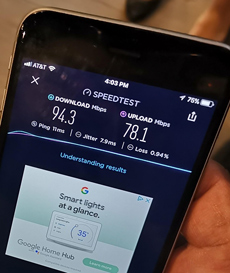
Gordon Mansfield of AT&T "told [management] that I want every day that’s left in the year ... The equipment is literally coming off production lines and going into the field — we are not even using normal shipping channels.” AT&T is the first in the world to use 39 GHz, a remarkable achievement.
AT&T has one of the best and most experienced senior engineering teams in the world, but the first efforts are struggling. It claims the supplier - probably Ericsson - isn't ready with the equipment in the 39 GHz band. They refuse to provide information on network speed. It may be as low as 250 megabits, half the LTE speed at T-Mobile in Manhattan.
Lessons learned:
“Now, in mmWave, it’s a new frontier. Sometimes you expect the signal to be there and it isn’t, so you have to adjust. As you move through the coverage area, you will be served by different beams, and you have to understand transitions between beams,” said Hristov. “RF engineers have to be hyper-accurate about placing and facing nodes … [because] if you don’t land on the right beam, you won’t get maximum performance.”
]]>MIMO antennas extend the easily usable frequencies well beyond the 4.9 GHz band. The FCC took the first step with a Notice of Proposed Rulemaking. Claus Hetting of Wi-Fi Now kindly allowed me to reprint his report.
The FCC wants to introduce four new unlicensed subbands aptly named U-NII-5 to U-NII-8. In the case of U-NII-5 and U-NII-7 (a total of 800 MHz) a new scheme called AFC (‘Automated Frequency Control’) will protect some incumbent 6 GHz users (mostly point-to-point microwave links) from harmful interference, the FCC says. In these two subbands the FCC wants to allow the operation of ‘standard-power access points’ equivalent to current rules for U-NII-1 and U-NII-3 subbands.
Four new subbands and (some) new rules
]]> Sharon White at OFCOM is leading Europe to spectrum sharing, setting aside 3.8 GHz to 4.2 GHz, enough to make an enormous difference in carrier capacity. For monopoly spectrum, she is proposing buildout requirements to 90% of the land mass (not population), more rural towers (500), a limit on the maximum spectrum one company can own (37%), and using spectrum auctions to make these happen. The result will be better broadband at a (relatively) modest cost.
She's launched a consultation on 700 MHz & 3.6-3.8 spectrum auctions, including the buildout and tower-building requirements. The goal is an auction in the spring. Mark Jackson reports
The 700MHz Coverage Obligation
The binding coverage rules mean that up to two winning bidders would each have to, within 4 years of the award:
1. Extend good, outdoor data coverage to at least 90% of the UK’s entire land area within four years of the award.
]]> It's great that AT&T announced 5G and is moving forward. Unfortunately, information is so restricted that Mike Dano put quotes around "5G." If AT&T really were ready, they would be shouting from the rooftops. They aren't. Update 12/19 AT&T told Mike Dano they were using only 100 MHz of spectrum and two antennas. That will be much slower than good LTE. Also, people nor businesses can order the service even if they live in the right location. Consumers can only "express interest" and only businesses selected by AT&T qualify.
It refused to give any information about typical performance or basic details like how many homes are covered. I'm inferring that the performance is disappointing, although many are working to change that.
There is no charge for "at least 90 days," guaranteeing no angry customers will ask for their money back. Then they want US$70 for 15 gigabits, as expensive as LTE.
"The $500 hotspot will mostly be run on 4G LTE," Kellen writes. $500 is hundreds more than an LTE hotspot.
]]>Rick Merritt, one of the world’s best tech reporters, reports from Qualcomm Maui, “Data rates for the first batch of handsets will likely be limited to a few hundred Mbits/s.” The only test results were downloads of 140 megabits to 470 megabits. This is far less than the gigabit expected from millimetre wave.
A world-class engineer assures me the problems will be solved. Unless answers are found quickly, volume rollouts will slip into 2020. In addition, Qualcomm CEO Amon Cristiano confirmed they have no units for the most popular frequency bands, 600 MHz to 1.8 GHz, which require FDD. (Most spectrum from 2.3 GHz up is designated TDD, which is shipping.)
The first phones are slower than decent 4G and less than half what Verizon is delivering to homes. LTE is in the field delivering 500 megabits (T-Mobile, Manhattan and elsewhere,) For now, 80%+ of “5G” is slower than 4G. Really. The latest 4G lab results reach 1.5-2.0 gigabits. See http://wirelessone.news/10-r/1244-4g-verizon-telstra-2-gigabits Tens of thousands of towers are equipped with "Gig LTE," although there are very few phones.
"5G Hype Is Out of Control This Week" Sam Rutherford writes. "There was very little substance to be found.
]]> The newest LTE radios offer peak speeds up to 2 gigabits. With the right phone, you should receive 150-700 megabits down, occasionally more. These are lab results. Actual deployments are a year or two away. Huawei's BANDSpeed will increase that. BandSpeed also is a while away.
Today's best networks in the field peak at 750-1200 megabits. With the latest phones, you will often get speeds of 100-400 megabits and occasionally higher. These lab results suggest LTE speeds can go up 50% to 100% in the next few years. Uploads are more likely to be 50-150 megabits, unfortunately.
At left are speed tests from PCMag editor Sascha Segan. He achieved over 500 megabits ar a T-Mobile cell site at 45th St. and Third Avenue in Manhattan, as you can see in the illustration. Today, tens of thousands of locations worldwide offer "peak" downloads of a gigabit.
There is little new technology needed for these speeds, just more channels and additional MIMO.
]]>5G is now live in the centre of Warsaw. DT Polska writes me:
In ideal conditions and close proximity to the base station we managed to achieve transfers over 800 Mbps (around 830-850 Mbps) with means reaching current technological limit for a 100MHz wide spectrum.
In “daily-use” cases (farther away from the station, on a street, in our #5G_LAB building) we are registering speeds around 350-500 Mbps, which is really great considering the circumstances.
Important sidenote: while at the moment the 100MHz lets us theoretically reach around 850Mbps, in a couple of months, with future releases of the 5G standard this theoretical limit is likely to double. This means that with proper implementation real-life measurements should also improve.
]]>200 FDD Massive MIMO systems are on their way to True Thailand from Huawei. FDD has been in dozens of trials for two years, but this is the first announced deployment. British Telecom tells me their trial is going well; if that continues, they will deploy. This is important because most spectrum below 2300 MHz is FDD and currently carries most of the traffic. Tens of thousands of TDD Massive MIMO systems have shipped, most in the 2500 and 3500 MHz bands.
Huawei has tested the 32 antenna systems to 4.7 times the capacity of a two antenna system. T-Mobile expects actual performance in the field to be more likely 2-3X, especially to mobile phones. Ericsson's Kathy Egan in 2017 wrote me, "Capacity increase as compared to 2 transmit antennas is between 1,5x – 3x on average and 1,9x – 5x for cell edge." I don't believe they have announced substantial deployments, although several carriers are ready to go. Lund University notes line of sight performance is much better than NLOS.
]]>Verizon's Bill Stone tells Mike Dano at Fierce, "Verizon will essentially double its 5G Home channel configurations from 400 MHz to 800 MHz, and that the speeds and capacity available through the service would double as a result." With 400 MHz, many Verizon customers are getting close to a gigabit today. The doubled capacity can be deployed in many ways.
Speeds could be doubled from "300 to 1,000 megabits." Verizon could raise the top speed to 2 gigabits for consumers to outpace U.S. cablecos, now mostly at 1 gigabit. (Some cablecos are starting to offer 1.5 gigabits.) Very, very few consumers can make effective use of even a gigabit, but the evidence around the world is that customers buy speed even if they don't use it.
Raising the 300 megabit minimum to 600 megabits would be a welcome move. Ex-CEO Lowell McAdam said the Verizon 5G would be targeted at a gigabit for all. I was shocked when VZ instead said 300-1,000 on launch. My initial thought was they were just covering their rear on problem cases, but then Vestberg said some customers would not get mmWave but something slower.
-----------------
The additional capacity can be tuned to raise speeds, serve more customers, deliver better service to businesses, or extend reach. I suspect the decisions haven't been made yet and marketing will play a large role.
]]>