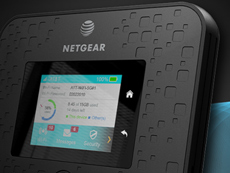
 It's great that AT&T announced 5G and is moving forward. Unfortunately, information is so restricted that Mike Dano put quotes around "5G." If AT&T really were ready, they would be shouting from the rooftops. They aren't. Update 12/19 AT&T told Mike Dano they were using only 100 MHz of spectrum and two antennas. That will be much slower than good LTE. Also, people nor businesses can order the service even if they live in the right location. Consumers can only "express interest" and only businesses selected by AT&T qualify.
It refused to give any information about typical performance or basic details like how many homes are covered. I'm inferring that the performance is disappointing, although many are working to change that.
There is no charge for "at least 90 days," guaranteeing no angry customers will ask for their money back. Then they want US$70 for 15 gigabits, as expensive as LTE.
"The $500 hotspot will mostly be run on 4G LTE," Kellen writes. $500 is hundreds more than an LTE hotspot.
]]>A world-class engineer assures me the problems will be solved. Unless answers are found quickly, volume rollouts will slip into 2020. In addition, Qualcomm CEO Amon Cristiano confirmed they have no units for the most popular frequency bands, 600 MHz to 1.8 GHz, which require FDD. (Most spectrum from 2.3 GHz up is designated TDD, which is shipping.)
The first phones are slower than decent 4G and less than half what Verizon is delivering to homes. LTE is in the field delivering 500 megabits (T-Mobile, Manhattan and elsewhere,) For now, 80%+ of “5G” is slower than 4G. Really. The latest 4G lab results reach 1.5-2.0 gigabits. See http://wirelessone.news/10-r/1244-4g-verizon-telstra-2-gigabits Tens of thousands of towers are equipped with "Gig LTE," although there are very few phones.
"5G Hype Is Out of Control This Week" Sam Rutherford writes. "There was very little substance to be found.
]]>Speeds could be doubled from "300 to 1,000 megabits." Verizon could raise the top speed to 2 gigabits for consumers to outpace U.S. cablecos, now mostly at 1 gigabit. (Some cablecos are starting to offer 1.5 gigabits.) Very, very few consumers can make effective use of even a gigabit, but the evidence around the world is that customers buy speed even if they don't use it.
Raising the 300 megabit minimum to 600 megabits would be a welcome move. Ex-CEO Lowell McAdam said the Verizon 5G would be targeted at a gigabit for all. I was shocked when VZ instead said 300-1,000 on launch. My initial thought was they were just covering their rear on problem cases, but then Vestberg said some customers would not get mmWave but something slower.
-----------------
The additional capacity can be tuned to raise speeds, serve more customers, deliver better service to businesses, or extend reach. I suspect the decisions haven't been made yet and marketing will play a large role.
]]>
Cayetano Carbajo, CTO Germany. has now announced that is exactly what they are going to do. They will offer fixed wireless to 25% of Germany, about 10 million homes, beginning in 2019. They are the first in Europe to commit to mmWave; everyone else in Europe is sticking to 5G/4G mid-band hybrids. Mid-band 5G is 4G hardware plus NR software. The capacity is similar to 4G, a gigabit + in the lab and 100-400 megabits to most customers.
Verizon is doing 25% of the U.S. and is already serving customers with close to a gigabit. See Verizon 5G: "I'm getting speeds of 900+ mbps downstream 200+ upstream."
Planned right, the cost is so low Verizon can cut capital spending. Hans Vestberg at Verizon estimates US$250-400 per home passed, half the cost of fibre. Reaching 25% can be done merely by upgrading existing cell sites, relatively cheap.
]]>Latency is 10-25 ms, not 1 ms. Verizon & AT&T latency from the cell to the home is testing at 9-13 ms. That's of limited value unless the game or whatever you're accessing is stored locally, unlikely for years. The important latency figure is from you to where you are trying to reach, sometimes across the web. 1 ms works in the lab but I do not know any telco in the world committed to deploying it in the next few years.
Dexter Johnson at IEEE reports a failed installation. Verizon tried, but was blocked by a neighbour's garage.
]]> 5G is not going to be an expensive network build, according to Verizon, NTT DOCOMO, France Telecom, and Qualcomm. The latest data come from Qualcomm, the only company able to demonstrate a mobile phone sized set of chips. Qualcomm simulations, based on data from several test trials, show existing towers can cover two-thirds of most cities.“Based on our extensive over-the-air testing and channel measurements, significant outdoor coverage (> 65%) is possible utilizing actual existing LTE sites. The 65% coverage figure is outdoor only. mmWave is blocked by some wall/windows and passes through others. Verizon is using outdoor antennas but hopes to allow customer self-installs indoor.
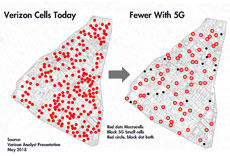
Upgrading existing cells first drastically brings down costs. Verizon and I believe AT&T are choosing to do most mmWave from existing cells. The illustration is from a Verizon presentation. It shows a dense area where fewer cells are needed in 5G. In areas like this, the greater capacity of the new tech allows shutting down cells. Verizon hasn't given us enough data to know what percent of the network can have fewer cells. They certainly will not be able to reduce the number in rural areas, where they are needed for coverage.
]]> Ted Rappaport pointed me to Jerry Pi's paper from 2011, one of the very earliest contributions to 5G mmWave. Pi wrote An introduction to millimeter-wave mobile broadband systems when was at Samsung. He writes, "The first publication is a patent application in 2010. As you know, Samsung was the first to show a 28 GHz 5G demo to the world in 2013, while most other companies just started to look into this idea. In my view this certainly helped Samsung establish its technology and product leadership in 5G and grow its 5G business."
Samsung's leadership in wireless research is paying off big time, with Samsung now supplying Verizon. Samsung's showcase customer is Reliance Jio in India, now with 225 million 4G subscribers after only two years. Jio and China's 344M fiber home lines connected (not passed) are the two most spectacular achievements in my 20 years reporting broadband.
In 2012, Samsung became true believers in mmWave and put hundreds of engineers to work. (Ted visited and presented to them.) The complexity of chips and networks today is astonishing. An effort like Samsung, Qualcomm, or Ericsson involves thousands of engineers and billions of dollars.
]]> Without Ted Rappaport, Verizon would not be turning on 5G today. In 2012, almost nobody believed millimeter wave was practical for consumer wireless. In 2013, NYU's Ted Rappaport wrote Millimeter Wave Mobile Communications for 5G Cellular: It Will Work! based on thousands of tests his team did in the skyscrapers of New York. (Abstract below)
Ted's results were much better than almost anyone else expected and inspired the Nokia and Ericsson to confirm with their own testing. On October 1st, 2018, Verizon is turning on a true gigabit 5G network. Yes, I realize my headline is an exaggeration. Someone else would have discovered the properties of mmWave, probably years later. We wouldn't have it today.
He just won the Armstrong Medal from the Radio Club of America. He's particularly honored to win this because, "when I was a dirt poor college student, and newly married, this organization gave me a scholarship that helped me decide to stay for grad school instead of taking a job."
]]>"The actual details of Verizon’s service are decidedly mundane.
1. Verizon is still going to have to do a truck roll.
2. Verizon isn’t providing 1 Gbps speeds.
3. Verizon is going to trash all this equipment next year anyway.
]]>Verizon is spending $20B on mmWave, which has ~ 3X the capacity of anything else. CEO Vestberg believes the greater capacity will allow them to leave competitors in the dust. All of Europe, as well as China, are choosing mid-band 5G. Mid-band, including 3.5 GHz, has 70-90% less capacity. That's enough to easily meet likely demand well into next decade, most believe. Telcos are betting US$billions, sometimes tens of billions, they are making the right choice.
My take is that Verizon will get an excellent return on the investment. They have no landlines in 80% of the United States where they have more than 75 million mobile customers. The picture is less clear where an incumbent covers the entire country, almost all the rest of the world.
Wireless technology is improving at a ferocious rate. WIthout raising capital spending, telcos can increase capacity six times or more in the next few years - without millimeter wave. (below) Meanwhile, demand growth is slowing down. Cisco predicts it will fall to 30% per year in the U.S. in 2021. CTIA - the telcos' organization in D.C. - reported growth was only 11% in 2017. That's so low I'm sure it is an artifact, but the trend is clear worldwide.
Six-fold capacity improvements are enough to cover 30% growth rates well into the 2020's at most carriers. If so, who would buy the additional capacity of mmWave? Bruno Jacobfeuerborn's questions about the business case are another way of asking, "Who will buy?"
Vestberg hasn't provided any details about where he sees the demand coming from. He's one of the best in the business, so maybe he sees something we've all been missing.
In addition, the extra speed/capacity of millimeter wave may prove an extraordinarily effective marketing tool. Customers are buying landline gigabit service even though there are very, very few practical uses for more than 100 megabits or so. If you offer a true gigabit over mmWave, you will clearly be the best in almost any market. It's likely that will be a powerful customer magnet.
The lifetime value of a mobile customer is in the thousands; even modest additional sales will be enough to cover the additional cost of the better network. Verizon's entire business strategy is to be perceived as "The best network in the U.S.," allowing them to charge a premium. The network advantage has almost disappeared the last few years. T-Mobile is faster in many cities. Even our worst network, Sprint, is good enough for most people.
Verizon's world first and largest millimeter wave network in the world will not just be perceived as better, it objectively will be better. The others could argue, accurately, that the difference doesn't matter. That's almost always has been a losing battle.
"The best network" strategy may pull one network ahead of the pack. What will happen if a challenger network, like Free in France, clearly has a better network than the incumbent? I haven't spoken to Xavier lately, but I'm sure he is thinking of it. Leapfrogging to mmWave may be a very effective move for Telefonica in England and Germany as well as many others.
Verizon is telling the world the cost of mmWave is much less than most people believe. They've done more testing than anyone else and are often getting a gigabit 600 metres. That brings the cost down significantly. It also has a strategy of first upgrading the existing 60,000 cells to full 5G. That should prove much cheaper than first building a small cell network. The extra capacity will be enough in high demand locations to decommission some towers. (The illustration from Verizon shows fewer cells with 5G. That won't be true in less dense locations, where more cells are needed for coverage.)
Will Voda or Free or ? grab the market with mmWave. There's no way to know, but it's clearly possible. Upgrading a network takes years, including training thousands of employees. In networks, it's impossible to be a "fast follower." I believe it is almost certainly prudent for every mobile carrier to at least heavily trial mmWave, build systems, and educate staff.
Being ready to deploy rapidly is cheap insurance against a competitor's move, even if it's not right to deploy mmWave in volume today.
(This is a first look to get the discussion going. There are no easy answers. Let's talk some more.)
Technologies changing everything
My belief that a six to ten-fold (or higher) capacity improvement is possible developed chairing Marconi Society seminars with Paulraj, Samueli, Cerf, & Rappaport. I've since discussed it with respected engineers inside the giant telcos who can't speak on the record. Lee Hicks of Verizon indirectly confirmed this estimate when he told an Adtran event his costs had been falling 40% per year and he hoped to continue at 40% going forward. The engineers all know this; the policy people often don't and make some very bad decisions.
Massive MIMO, whether in 4G or the very similar 5G midband, directly produces a two to seven times improvement. MM opens up the 3.4-4.2 GHz band, previously impractical to use. Lightly used spectrum in the "mid-band" will allow an additional 100 MHz to each carrier, doubling available spectrum. Carriers are also adopting more complicated coding method (256 QAM) that adds as much as a third to existing systems.
Companies like Verizon and AT&T are only using ~50% of the spectrum they own today, confirmed by their CFOs. As four and five carrier aggregation reaches the market, this spectrum can be put to use. Carrier aggregation allows also using the Wi-Fi spectrum, LAA. T-Mobile is delivering 500 megabits in Manhattan with LTE/LAA.
Small cells are a relatively inexpensive way to add capacity just where it's needed. Small cells have been held back by interference problems; CTO Ibrahim Gedeon of Telus told me late in 2016 that was solved. Since then, especially in 2018 in North America, small cell deployments are taking off. Tower company Crown Castle has 40,000 already built and tens of thousands more in the pipeline.
]]>- Verizon will add 5G millimeter wave to all their existing cell sites. (I estimate 60,000-70, 000.) This brings about 30M homes out of incumbent territory within 2,000 feet. He expects that to be mostly completed by 2022.
- Verizon has demonstrated a gigabit at 2,000 feet, although I believe VZ has provided no data on what percent of customers within 2,000 feet will actually be gigabit capable.
- Based on a large rollout in 2019 going forward and matching the 35% to 40% take rate for Fios, he calculates a likely 7.9M subscribers for 2023. Verizon today has only 7M broadband customers.
- Feldman expects Verizon mostly to upgrade existing cell sites rather than build many new ones in this period. He sees little increase in capex. I calculate that will allow Verizon to reach ~40% mmWave coverage, including incumbent territory. They will have "Gigabit LTE" elsewhere delivering speeds in the hundreds of meg.
- $50/month is the most likely price but he expects Verizon to experiment.
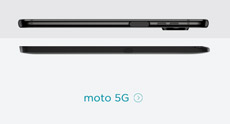 Add-on to come next year, at unknown price. It's the existing, not very impressive $480 Lenovo-Motorola Z3 and a promise of an add-on with a Qualcomm X50 modem. As you can see in the picture, the module is designed to snap on.
Ted Rappaport promises 5G phones by Xmas, but the quantity will be limited. The industry expectation has been "some" production units in the first half but quantities would be severely limited until the second half.
Verizon's suggestion these will be readily available early in the year is surprising. The whole 5G schedule has already been pulled up by a year, an extraordinary achievement in an almost unbelievably complicated product.
Modular, upgradeable phones like this have been around for a long time. They've never found much of a market. You generally take a performance hit if you only upgrade part of the phone. New phone prices kept coming down; if you needed a new function you probably bought a new phone.
A brilliant pr move calling this a 5G phone when it can't do 5G.
]]>After that comment, the industry accepted calling almost everything "5G," including 5G Low in 3.5 GHz spectrum. That's 70%-90% slower, really 4G with a software tweak (New Radio.) Especially in China, 3.5 GHz networks may be built early in 2018.
In July 2018, Skyworks CEO Kris Sennesael didn't see much demand for either type of 5G until late in 2019. Skyworks supplies frontend radio frequency parts to almost all the phone makers and has a clear view of the market.
What we’re seeing today is a lot of design activity on both the infrastructure side and also on really kind of a heartbeat of the connectivity within smartphones. We think, again, you can get different answers, but we see revenue really being posted probably by 2020, maybe late '19. But 2020 is where I think kind of we translate around real revenue. (Seeking Alpha)
Getting the first 5G phones for Xmas, as Ted Rappaport predicts, is very exciting. But it probably will be Xmas 2019 or a little later for enough units to ship to affect any bottom line. It will take at least another year after that until they are in mid-priced phones.
]]>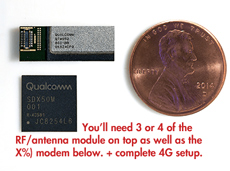 "I told you 5G mmwave phones would be ready by Christmas," email Ted Rappaport, the "Prince of mmWave" and NYU Professor. A second source confirms the likelihood of “a few hundred” phones this year. Qualcomm has now announced they are sampling a small, highly integrated radio frequency and antenna module, the QTM052. I believe they will imminently announce they are sampling the X50 baseband modem and supporting a reference design.
Qualcomm is delivering a year before almost everyone expected the phone. mmWave antennas are really small. One guess is that the little unit at left has 8 of them. The small size of the unit is remarkable. Nothing is certain, of course, until production units are shipping.
Intel, Huawei, and Samsung are chasing as fast as they can as well. Skyworks, Broadcom/Avago, and Qorvo are rushing to have their RF frontends available as well. To protect against U.S. boycotts, the Chinese are speeding research in RF as well.
The early phones will be big, drain batteries rapidly, and very expensive. Few expect large volumes before 2020 and maybe later. No one except Verizon has committed to a major mmWave network this decade, although AT&T, Korea, and China are possible.
]]>
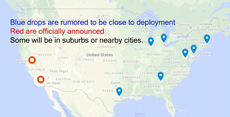 Atlanta, Houston, Detroit, Boston, Chicago, D.C., & Philadelphia/New Jersey - or a city nearby - appear to be close to ready to go commercial. Only Sacramento and Los Angeles are announced. This is not a firm deployment plan.
Verizon has been doing trials in eleven cities. They are running fiber and beginning to deploy in literally hundreds of other places. They will make final decisions based on the results in each city, marketing, and politics. They've publically committed to 1,000 base stations by the end of 2018, the largest mmWave deployment in the world. That would likely be enough for 3 to 10 square miles per city, but it will not be evenly distributed.
Millimeter wave performance differs enormously based on terrain, height, foliage, and even traffic. Verizon trials and early deployments are locations with different physical features.
]]>Google just ordered 62,000 autonomous Chrysler Pacificas to add to their fleet of 600 driving around America, That's convincing proof "Autonomous cars do not need 5G," as Gerhard Fettweis told the Brooklyn 5G Summit in May.
It will be years before millimeter wave can reach more than a small fraction of roads. Universal coverage would take decades. The millions of miles Google cars have driven leaves no doubt autonomous cars can drive safely using radar and lidar, although more work is needed.
Karl-Heinz Laudan of Deutsche Telecom agrees. "Automotive does not need mmWaves," he told an important European Union event May 30th in Brussels.
]]> AT&T is so big people in different parts of the company often have different opinions. An insider told me T was going to use millimeter wave widely, believing it would attract enough customers to pay off. He saw it as a land grab situation against Verizon, who is firmly committed to tens of millions of homes passed. "Whoever is first with 5G millimeter wave will win 10% to 20% of customers away from cable. We will be in a race to be first in many parts of the country." Their technical people have been preparing a large build. At least one thought the company strategy would be like Verizon, deploying quickly to get that first mover advantage.
The man with the money is dubious. He's more inclined to grow fiber home where they already have fiber nearby. It's "Very inexpensive." He wants to focus on building fiber to the 30M homes passed by U-Verse in district. They've already fibered 10M of them and are doing 3M/year. Broadband in district has been flat to down. They are getting clobbered where they haven't upgraded. So protecting a "fortress AT&T" is a sensible strategy.
]]> 3/4ths of the U.S. won't even be available in the highly touted 28 GHz auction. There is essentially no spectrum available in the crucial 28 GHz spectrum band in the top 50 markets.
Verizon controls 76% of the 28 GHz band in the top cities (The red in the chart.) TMO has 12% and another 10% is spoken for. Only 2% will be available for auction. Verizon has 46% of the 39 GHz band and AT&T 30%.
Stephen Wilkus, a veteran of Bell Labs and Alcatel-Lucent, calculates the 28 GHz auction will only cover 23.7% of the U.S. population. Much will be rural, inappropriate for the short reach of mmWave. .
]]> Verizon 5G reach is perhaps twice as far as expected, including with obstacles (NLOS.) That's the independent conclusion of Michael Thelander and team testing two live Verizon cells in Houston,
"Who would have thought a millimeter wave signal in an area 100% blocked from the serving cell tower by the surroundings would still be capable of supporting good data speeds?" they exclaim. "Millimeter wave signals are far more resilient than we expected, even at distances exceeding several thousand feet. Tree foliage, passing school buses, buildings, parked cars, balding heads, and glass impacted the received signal, but the resultant signals were still capable of delivering meaningful data rates – thanks in part to the 400 MHz radio channel. Verizon can deploy 800 MHz channels in some markets." The results were generally good up to 1,000 meters and behind buildings.
At MWC Barcelona next week, there will be dozens of analyses on mmWave costs and buildout requirements. Nearly all of them will assume reach of 200-300 meters. That would require at least hundreds of thousands of cells to cover the U.S. and probably millions.
They probably are wrong.
]]>"Who needs fiber?" everyone was asking. Grahame Lynch predicted three years ago that wireless would be fast enough that the fiber broadband network was unnecessary. It's not that simple, but the new wireless certainly will be enough for many.
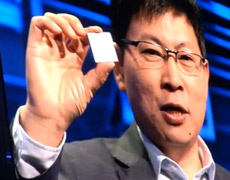 The $B Balong 5G01 is a remarkable achievement and big news. The release is below: It's a mainstream, 3GPP standard chip that's very similar to the advanced chips of leaders Qualcomm, Intel, and Apple. The processor cores are ARM. They showed off working routers for both < 6 GHz and mmWave. There are different chips for the two frequency ranges. These are first generation chips; second generation, due later in 2018, will be smaller. They expect routers for sale this year and phones in 2019.
Verizon is planning at least hundreds of thousands of 5G mmWave cells, many of which will be backhauled using NG-PON2 from Calix. (Below.) Recently, Brett Feldman of Goldman Sachs projected Verizon is spending $20B over the next several years; from different sources, I came to a similar conclusion last year.
"Verizon's announcement is legitimizing NG-PON2," Carl Russo of Calix asserts. "It's the right choice today for 5G and customers who need the failover reliability. Because you can switch wavelengths almost instantly and upgrade easily, it's very attractive for customers with growing demand."
He added, "The cost will come down with volume and time. Today, it's the right choice for many; going forward, we expect a very wide market."
NG-PON2 requires expensive lasers of a kind that haven't been mass produced. A half-dozen companies, Adtran as well as optics specialists, are working furiously to bring down the cost.
]]>NTT DOCOMO's very respected CTO Seizo Inoe in 2016 called high costs of 5G "a myth" in presentations at the Brooklyn 5G Summit and an IEEE conference in Kuala Lampur. He pointed out that LTE was cheaper than 3G and that much of the 5G would use existing towers and backhaul.
Vestberg, former Ericsson CEO now running Verizon's network, sees mmWave costing $200-400/home passed as they deploy to a quarter of the U.S. (Obviously, some other areas will be more expensive.) He just told a CITI investor conference 5G is
"Massively, massively cheaper than having a fiber all the way to the home to have sort of a beam in the air going to the home."
Verizon has previously said their costs to pass a home with fiber were $700 in 2007 and went down from there, presumably to $400-600. AT&T has confirmed similar as they deploy 15M lines of fiber home. I'm inferring that "massively, massively cheaper" would be $200-$400.
]]>
The "device" may be a tablet or laptop.
The headline "AT&T to Launch Mobile 5G in 2018," led me to ask whether Intel or Qualcomm is moving their mobile phone chip delivery dates up yet another year. Most telco engineers were amazed when both companies moved delivery from 2020 to 2019; could they now move up to late 2018?
It's not impossible; TSMC will be in "risk production" of 7 nm, probably required for mmWave phones. Linley estimates the mmWave chips will require 10X the transistors of 4G, raising major questions of heat and power until 7 nm. There are thousands of engineers working furiously to get the chips out the door, but this would be remarkable.
]]> At Huawei's London MBBF, BT CEO Gavin Patterson went first, saying, "The business case isn't there." DT CTO Bruno Jacobfeuerborn, adding "For 5G, Deutsche Telekom still has no business models." FT/Orange SVP Arnaud Vamparys followed with a second agreement.
3,000 miles away, Verizon was finalizing the announcement that they would rush to deploy ~30M homes of 5G mmWave. At NGMN and elsewhere, the top tech people share freely what they know. All are working with essentially the same understanding. How can we explain the different choices?
Verizon landlines cover only about 1/4th of the U.S. They need an offering to compete with cable and DSL.
]]> A gigabit median at 600 meters. A year ago, most experts expected mmWave to be limited to 150-250 meters. Earlier this year, Verizon mentioned good results at 400 meters. Now, Verizon is often seeing excellent results to 600 meters and further. A gigabit is common.
The result is that far fewer new cells are required. The green dots are where Verizon already has cells. As you can see, there are few red dots for new cells. The cost is coming in so low Verizon does not expect to raise their capital spending. "Management stated that overall capital expenditures would not change substantially during the 5G rollout as internal resources are shifted from the 4G to the 5G platform."
It will be fixed only in 2018, with Verizon promising to support mobile as soon as the technology is available. Intel and Qualcomm expect 5G phones in production in 2019.
Ted Rappaport of NYU has long had an alternate "channel model" that predicted higher speeds, now confirmed.
]]>So I was surprised when I discovered Verizon VP Charla Rath in spring 2016 wrote, "Just as Verizon invested billions to be the first mobile carrier to deploy our world leading 4G LTE network, we plan to do the same for 5G. Sanyogita Shamsunder, Verizon’s Director of Wireless and Technology Strategy, outlined this commitment during the opening panel."
]]>2019 for mobile phones, Qualcomm promises, as TSMC ramps 7 nm process to produce the chips.
Latency will be 5-10 milliseconds to the cloud controller intelligence.
1-2 milliseconds will be measured from the tower to the phone, but that's meaningless until and unless intelligence moves to the edge. That's likely very rare for a decade because there's no apparent market for 1 ms. Most "use cases" are bogus according to experts in connected cars, virtual reality, and telemedicine. Gerhard Fettweis's Tactile Internet is inspiring but years or decades away most places.
]]>
Phazr's base station is about two feet high and a foot wide. That's large enough for 384 antennas per sector, three sectors per cell. That's massive, massive MIMO. It's made possible by the very small size of mmWave antennas.
Phazr's system uses mmWave for the download but ordinary spectrum below 6 GHz for the upload. This has the advantage of requiring much less power in the mobile phone, producing less heat.
]]> 2019 Mobile 5G Phones! blazes on ads across the trade media from Qualcomm. "You’ll see 5G in 2019 for sure," Qualcomm CEO Steve Mollenkopf promises. Verizon has begun a huge, rapid deployment of mmWave, with hundreds of sites installed.
Mollenkopf himself thought it would be 2020, but new technology is allowing him to chop a year off the schedule. His main foundry, TSMC, has begun "risk production" of 7 nm chips, the next generation. It's reasonable to expect volume production in 2019. TSMC is taking delivery in 2018 on $150M EUV machines to improve critical layers. Steve is going for 2019 because he can.
Verizon will be ready to serve mobile 5G "as soon as phones are available." China Mobile and AT&T are also looking to build early. They will be expensive and probably power hogs, but a true gigabit should be possible. ("Gig LTE" will usually be 75-300 megabits to the customer, per Qualcomm.)
]]> September 13's announcement by Lowell McAdam will go down in history as the date of the first real 5G mmWave deployment. True speeds of a gigabit are possible, rather than the 100-300 megabits more common with "Gig LTE."
We literally have hundreds of cell sites that we have up and operating and 8 markets moving to 11 markets. The global standards will be done we believe sometime this year. The chip manufacturers will have chips available in the first quarter next year for us to incorporate that are on the global standards. So this platform is not two or three years out the way it was a year ago, it's on our doorstep and I think it's going to be huge.
Fixed only at first, competing with cable. It will be 2019 or more likely 2020 before substantial numbers of mobile phones will be able to connect. Both Qualcomm and Intel have thousands of engineers at work and are optimistic about chip delivery dates. It will not be easy.
Verizon needs 5G more than any other company on Earth. Its business model is based on being better and able to charge a premium price. AT&T and especially T-Mobile have caught up in important ways. Independent testing by Open Signal has T-Mobile faster in many cities, although Verizon data disagrees.
]]>"We were at 2000 feet from the receiver in Samsung's Technology Park, we were delivering 1.8 gigs. We said, "Okay, take that truck, drive it around the backside of the building," so there is no possible way you will have a direct line of sight, 2000 feet away, it delivered 1.4 gigabytes of throughput. And the reason was that it took all the different reflections and the computers were able to process and then get that signal back up."
]]>2017's biggest announcement - unless China does similar. NTT Docomo CEO Kazuhiro Yoshizawa plans to go "nationwide" by 2023, per the generally reliable Nikkei Asia Review. The estimate is that the three Japanese telcos (DOCOMO, KDDI, Softbank) will spend a total of ~$45B, some of it on shared infrastructure, The story has been picked up by more than a dozen publications but that's about the only details we have. (If DOCOMO is spending half of the $5G, that's about $200/person servable.)
DOCOMO has been dropping hints for several months. I'm hoping for a detailed announcement either at the June 20th shareholders meeting or the next quarterly conference call. Nikkei has a May 22 comment from Yoshiwara "We will lead the world with our 5G technology."
]]>Verizon would not be spending $4-7B on fiber backhaul unless they were putting $10's of billions of gear in the field. Moffett and Del Deo confirm that $1B spent of fiber implies an investment about five times greater when labor and other costs are added.
Verizon would have bought some spectrum in the auction unless they had alternate plans to add a great deal of capacity. One report has speeds on the Verizon network falling 14% since they went unlimited. Wireless growth had been falling, but with "unlimited" people aren't switching to Wi-Fi as much. The evidence is early but the trend pretty clear.
No one, not even Verizon, can offer reliable coast estimates on the 5G small cell build. There is simply no data.
]]> "The industry needs to be less hasty and more pragmatic." Enrique Blanco of Telefónica supports 350M users and has been deeply involved in 5G from the beginning. Speaking to Mobile Europe, he said openly what many others are saying privately: getting 5G right could be "damaged" because some companies are rushing to get pr quickly.
“My personal view is those operators who are really pushing for this – in the US, and Japan, and Korea – have different, more urgent priorities," he said. "Because of the Olympics, and whatever else, they want to deploy services using NR much sooner – which means they need the standards to be defined sooner. Too much is at stake."
"So what's new? They simply end up extending 4G capabilities [with] little differentiation from advanced LTE technology.
]]> Suddenly, it's possible and happening. Costs are down; performance and reach up; "commercial deployments" moved to 2019 by Verizon and AT&T; mobile may be ready for 2020. Engineers like NTT CTO Seizo Inoe are moving up their forecasts for time to revenue. Tests are going better than expected. Most of the challenges holding back big telcos are being solved.
Nothing is certain, but many top engineers are close to convinced. I believe McAdam at Verizon has decided to go full speed ahead. Six months ago, then CFO Fran Shammo told Wall Street not to put 5G into their capex models for several years. He wanted to see the test results in 2018 before going ahead. Since then, Fran's been replaced by Matt Ellis. Verizon changed 2017 test plans from a few homes near their Boston research labs to 11 cities around the country. They've made a firm commitment to a "commercial deployment" of fixed in 2019.
]]>Many answers also require estimates of traffic demand, how much people are willing to pay for what technology, whether connected cars require 1 ms, 5 ms, or 10-30 ms latency, and many other datapoints not covered here. In particular, "unlimited" offerings are driving up traffic demand far above expectations even six months ago.
]]> The gleam in Lowell McAdam's eye discussing his future network was a hint. Verizon's purchase of $1B of Corning fiber convinced me the decision had been made to go to a one-third to one-half the United States. I have no inside information; the CFO didn't have too many drinks one night and spill secrets. Rather, the evidence and the logic drove me to believe this will soon be the largest network build in the Western world. It really doesn't look like Verizon will buy Charter (or whomever.) Making looks much cheaper than buying. It's also possible the 2017-2018 testing will be severely disappointing. They can change their decision until 2019-2020, when the spending gets heavy.
The evidence below needs to be considered alongside this separate article about what's inspiring Verizon to go ahead. The technology is (almost) ready. 5-20 gigabits is working in the labs and 10,000 engineers around the world are pushing forward. VZ is being killed by cable across the unfibered half of their territory. AT&T is making noise about going out of territory with wireless to the rooftops & gigabit to the apartments. The business logic is strong.
]]> Most previously expected deployments before 2022 to be extremely modest. The highly respected NTT DOCOMO CTO in 2015 predicted little mmWave mobile before 2022-2023. That became the common wisdom among leading engineers despite the massive pr it would be sooner. At the Brooklyn 5G, he acknowledged advances have been made and he now expects sooner. Ted Rappaport is no longer the outlier on projected volume deployment. Nothing is certain yet, but many think Onoe is on target. 3GPP, under pressure from telcos, is cooperating.
3GPP, under pressure from telcos, is cooperating. They are expediting the ridiculously named "5G New Radio Non-standalone." That's mostly a 4G LTE system with some software tweaks and the ability to use mmWave as well as Wi-Fi spectrum. The existing LTE network will handle the hard stuff,
]]>
Small cells: fiber: Exchange: Cloud RAN: Core: Internet or PSTN. I believe Verizon has made the decision to spend ~$20B and add enough small cells to cover 1/3rd to 1/2 of the U.S. The major construction will be from 2019 to 2022. ]]>
Verizon has decided to spend $20-25,000,000,000 on 5G millimeter wave to 30-40,000,000 homes, I believe. This is not a test, trial, or “part of 11 cities” deployment. This will be the largest new network in the western world.
1/3rd to 1/2 of the U.S. will be covered. In 2019 - if all goes well - they will begin installing between 100,000 and 300,000 small cells. They hope to finish this phase in 2022 or 2023.
Each cell will have a 4G/5G upgradable radio and will immediately add capacity to LTE, right where it’s most needed. That’s why Verizon didn’t buy any spectrum in the auction; LTE & LAA will provide what’s needed, even with an “unlimited” offering.
]]>Looking back four years later, most of what Ted, Samini and team wrote in 2013 is confirmed. This article was triggered when I noticed then NYU grad student Mathew Samini was an author on 15 major papers in three years (below.) These included the propagation test data and a more accurate Statistical Channel Model, an essential for designing networks. (Abstract below.)
Verizon will soon turn on millimeter wave to (a very few) homes in 11 cities; the Koreans have major plans for the next 15 months. It does work. The NYU team performed tens of thousands of tests in Manhattan as well as in Brooklyn. Their data was convincing. Four years later, $billions are being spent to solve the remaining problems and start to connect hundreds of millions.
]]>It does work! Throughout the show, two large screens showed live data from a 1 GHz mmWave + 4x4 LTE MIMO system. The results were consistently between 19 gigabits and 21 gigabits. About 1 gigabit was LTE, an example of the gigabit LTE that will be sweeping the industry in the next two years. The mmWave gear ran consistently at 19 or 20 gigabits. While Huawei said nothing about availability, I infer 2020 is the target for working production equipment for mobile.
Not one of the dozens of network engineers I've spoken to lately disagreed with Ted Rappaport's conclusion "It will work." While we have no field results on millimeter wave to consumers, there are decades of results of mmWave for backhaul, high-speed point to point wireless, and heavy military usage.
]]>He acknowledges that BT still has a long way to go in LTE deployment. While they claim 99% population coverage with LTE, these maps from Open Signal suggest they are not using a robust measure of actual coverage. The map above is based on tested connections to LTE. Below, the 4G and 3G maps are side by side. Note how many places 3G is working but you can't even get 4G. That's strongly suggestive of either a crowded LTE network or optimistic coverage estimates.
Karonis is strong on the need for reliability, particularly as BT adds security services as customers.
]]> Ted Rappaport of NYU, the world's foremost mmWave researcher, disagrees with my guess that mmWave 5G will be modest until 2021-2023. My opinion is backed up by opinions from several carriers and an estimate from Ovum that fewer than 1% of lines will be millimeter wave in 2021. Ted's opinion is shared by Verizon CEO Lowell McAdam, who will deploy in Boston and probably San Francisco as soon as Verizon can get the equipment. That should be late 2017 or early 2018. Nokia and Ericsson have hundreds of engineers working on 5G mmWave.
I will be delighted to be proven wrong and see more rapid progress. Since my comment, Rappaport and team have published a seminal paper, Millimeter Wave Wireless Communications: New Results for Rural Connectivity (Abstract below.) They were able to detect a 73 GHz signal 11 kilometers away from their transmitter, a carefully aligned antenna 110 meters above average terrain. (Pictured.) They used 1 watt of transmitter power, levels similar to today's mobile phones.
]]>AT&T & Ericsson are working on phased arrays with ultra-fast beam steering, feedback-based hybrid precoding, multi-user multiple-input/multiple-output, dynamic beam tracking and beam acquisition. Beamforming and related technologies seem may be a breakthrough that extends the reach and throughput of mmWave systems. mmWave Works!, as Ted Rappaport proclaimed a few years ago. The question now is where it will prove financially practical. All those small cells and backhaul can be very expensive.
The day will mostly be devoted to connecting and automating cars, with top speakers. Robert Heath of the University of Texas is one of the organizers; he co-wrote the book on millimeter wave and is working to solve some of the remaining problems.
]]>